Filter
231
Featured
Free Access
208
Key Guidance
8
Quick Overview
1
Top Insights
10
Topics
Internet Governance, Internet Policies
53
Internet / Social Media Law & Regulation
38
Cybersecurity, Digital Safety, Privacy, Right to Privacy
33
Content Moderation & Regulation: Social Media
30
Digital Platform & Intermediaries Regulation
22
ICT Policies
18
Countering Hate Speech, Disinformation & Propaganda
17
ICT Regulation
15
Access to Internet & Digital Communications
14
Freedom of Expression
13
Hate Speech Legislation & Regulation
13
Big Digital Platforms, Big Tech Companies
13
Digital Platforms & Intermediaries
13
Freedom of Expression Online, Internet Freedom
12
Disinformation & Misinformation Law & Regulation
12
Telecommunication Infrastructure
12
Telecommunication Law, Regulation & Policies
12
Data Protection: Law & Regulation
9
Digital Media Censorship, Control & Filtering, Internet & Social Media Censorship
9
Mobile Phone Markets
9
Disinformation, Misinformation, Fake News
9
Media Law & Regulation
9
Communication Rights
8
Copyright Law
8
Hate Speech, Hate Speech in Social Media
8
Algorithms & Big Data
7
Artificial Intelligence
6
Ecological Footprint & Sustainability of Digitalization, E-Waste & Recycling
6
Intellectual Property
5
Surveillance, Surveillance Technologies, Spyware
5
Cybercrimes
5
Digital Ethics, AI Ethics, Social Media Ethics, Data & Information Ethics
5
Electronic Commerce
5
ICT Industries & Markets
5
Child Protection: Legislation & Regulation
5
Child Abuse: Digital Media
4
Digital Rights
4
Digital Entrepreneurs, Tech Entrepreneurs
4
Social Media
4
Facebook
4
AI Regulation & Legislation
4
Digital Industrial Policies
4
ICTs and Development
4
World Summit on the Information Society (WSIS)
4
Defamation Law & Regulation
4
Sexuality: Media Representation, Sexually Explicit Media Content, Pornography
4
Innovations
4
Safety of Journalists: Law & Public Policies
4
Media Freedom, Press Freedom
3
Telecentres, Community Telecentres, Internet Cafés
3
Digital Inclusion
3
Democratization & Digital Media / Social Media
3
Digitalization, Digital Transformation
3
Gender and ICTs / Internet
3
ICT Financing
3
Accountability & Transparency of the Media
3
Countering Defamation & Harassment
3
Self-Regulation of Media
3
Frequency Allocation, Radio Frequency & Spectrum Management
3
Human Rights Protection
3
Accountability & Transparency
3
Digital Switchover
3
Digital Television
3
Access to Media & Information
2
Access to Public Information, Freedom of Information, Right to Information
2
Open Data
2
Digital Activism, Cyber Advocacy
2
Digital & Social Media Use, Internet Use
2
Media Use: Youth
2
Child Protection Online
2
Open Licensing, Creative Commons, Public Domain
2
Media / Communication Control
2
Harassment & Intimidation of Journalists
2
Cyberbullying, Cyberharassment
2
Data Governance, Data Justice, Data Sovereignty
2
E-Governance, E-Democracy
2
Google
2
Digital Political Communication
2
Digitalisation, Online Communication & Democracy / Democratization
2
ICT Development Assistance
2
Media Monopolies & Oligopolies
2
Taxes
2
Gender-Based Online Harassment & Sexual Threats
2
European Union (EU)
2
Diversity & Pluralism in Media / Communication
2
Consumer Protection
2
Human Rights
2
Governance
2
Stakeholders, Stakeholder Analysis, Stakeholder Participation
2
Religious Populism
2
Internet & ICTs in Rural Areas
2
Discrimination
2
Civil Society
2
Digital Radio
2
Open Source Software
2
Telecommunications
2
Access to Information Laws, Right to Information Regulation
1
Advocacy Campaigns
1
Civic Engagement, Citizen Participation, Civil Society & Digital Communication
1
Civic Engagement, Citizen Participation, Civil Society & Media
1
Gender Advocacy & Empowerment, Gender Mainstreaming
1
Behavior Tracking & Cookies
1
Media & ICT Use in Authoritarian Regimes / Dictatorships
1
Authoritarian Regimes, Dictatorships
1
Media Law & Regulation: Authoritarian Regimes
1
Campaigning: Experiences
1
Children's Rights
1
Freedom of Expression Principles
1
Copyright: Music
1
Plagiarism
1
Geoblocking
1
TRIPS (Agreement on Trade-Related Aspects of Intellectual Property)
1
Censorship Circumvention Tools & Strategies
1
Press Freedom & Communication Rights Violations
1
Right to be Forgotten
1
Government Communication Strategies
1
Community Communication
1
Perpetrators
1
Cyberwarfare, Cyber Operations: Attacking Enemy Computers, Software, and Control Systems
1
Extremist & Terrorist Digital / Social Media Presence
1
Countering Misinformation & Rumours
1
Creative & Cultural Industries
1
Cultural Policies
1
Developing Countries
1
ICT / Internet Projects (Development Aid)
1
Media Assistance Projects & Programs: Case Studies
1
Good Governance
1
Digital Communication, Digital Media
1
Convergence of Media
1
Digital Skills, Digital Production Skills
1
Digital & Information Literacy
1
ICANN
1
Internet
1
Net Neutrality
1
Digital Financial Services, Mobile Banking, Mobile Payphone Business
1
Digital Journalism, Online Journalism
1
Digital Market Concentration
1
Digital Media Markets
1
Online Services
1
Search Engines
1
Ethnic / Minority Online Communities & Websites
1
AI Ethics
1
Economic Development: Role of ICTs & Media
1
Online Learning, E-Learning
1
Female ICT Sector Personnel / Professionals
1
ICT Economics
1
Information Society
1
Racism
1
Racism in Social Media & Digital Communication
1
Deepfakes (Realistic-Looking Media Content that has been Modified, Generated or Falsified Using AI)
1
Health Disinformation & Misinformation
1
Political Economy of Media
1
Energy Supply, Electricity
1
Labour, Labour Markets, Labour Laws, Working Conditions
1
Market Liberalization, Economic Liberalization
1
Outsourcing
1
Privatization
1
Schools
1
Educational Policies
1
Gender and Media, Gender and Communication
1
Female Journalists & Media Workers
1
Gender-Based Harassment, Intimidation & Violence
1
Gender Norms & Roles
1
Decolonial & Non-Western Approaches
1
Moderation / Facilitation Skills & Techniques
1
COVID-19 Communication
1
Indigenous Languages
1
China: Transnational Information Operations, International Broadcasting, Public Diplomacy
1
China: Foreign Policy, Foreign Investments, Development Assistance
1
Foreign Policies
1
UNESCO
1
Journalistic Practices & Routines
1
Media & Communication Terminologies
1
Media Assistance: Law & Regulation, Media Policy Consultancies
1
Media & Communication Policies
1
Media Literacy Policies
1
Economic / Social / Cultural Rights
1
Law, Legislation, Judiciary (General)
1
Radio Law & Regulation
1
Regulatory Bodies
1
Religious Freedom
1
Television Law & Regulation
1
Strategic Alliances, Strategic Partnerships
1
Citizenship
1
Civic Engagement, Citizen & Community Participation
1
Hindu Nationalism
1
Shrinking Spaces for Civil Society & Political Actors
1
State
1
Democracy / Democratization and Media
1
Election Campaigns: Social Media
1
Public Spheres
1
Public Service Broadcasting
1
Helplines, Hotlines
1
Islamism
1
Research in Media & Communication
1
Science Communication & Research Dissemination
1
Sexual Violence & Abuse, Rape
1
Coalition Building
1
COVID-19 Pandemic: Economic, Political and Social Effects
1
Computer Networks, Local Area Networks (LAN)
1
Network Software
1
Software Security
1
Technologies: Impact Assessment
1
Technology Transfer
1
Internet Bandwith, Broadband & Backbone Networks
1
Internet Service Providers (ISPs)
1
Telecommunication Companies, Mobile Phone & Fixed Line Operators
1
Telecommunication Industries & Markets
1
Telecommunication Licensing
1
Video Art, Video Culture
1
Language
Document type
Countries / Regions
Authors & Publishers
Media focus
Publication Years
Methods applied
Journals
Output Type
Who Moderates the Social Media Giants? A Call to End Outsourcing
New York: New York University Stern Center for Business and Human Rights (2020), 28 pp.
"Content moderation—the process of deciding what stays online and what gets taken down— is an indispensable aspect of the social media industry. Without it, online platforms would be inundated not just by spam, but by personal bullying, neo-Nazi screeds, terrorist beheadings, and child sexual ab
...
"1) Any definition of disinformation in legislation or other regulation, such as regulatory guidance, must take into account the serious implications for freedom of expression and media freedom. Particularly to the extent that provisions on disinformation have been adopted in criminal law, a precise
...
Working Group on Infodemics: Policy Framework
Key Guidance
Forum on Information & Democracy (2020), 127 pp.
"The Forum on Information & Democracy proposes a number of policy steps to democratic governments and their supporters. Transparency and accountability need to be shored up and content moderation should be done according to democratic mandates and oversight. The impact of new platforms where disinfo
...

"Divisive Internet regulation is fragmenting the formerly worldwide web into numerous shards that follow their own rules. The US, the EU and China are influential in shaping regulation even beyond their own jurisdictions, with consequences for human rights, particularly in Africa. This paper argues
...
Desinformation aufdecken und bekämpfen: Interdisziplinäre Ansätze gegen Desinformationskampagnen und für Meinungspluralität
Baden-Baden: Nomos (2020), 217 pp.
"Was macht Desinformation im deutschsprachigen Internet aus? Wie wirkt Desinformation? Wie kann sie mithilfe technischer Mittel erkannt werden? Was kann und könnte mit regulatorischen und rechtlichen Maßnahmen gegen Desinformation getan werden? Aus den Erkenntnissen von Journalistik, Medienpsychol
...

Secuencia e hitos de la polémica ley de las TIC en Colombia
Bogotá: Friedrich-Ebert-Stiftung (FES) (2020), 9 pp.
"La ley TIC (tecnologías de la información y las comunicaciones) 1978, aprobada en julio de 2019 por el Congreso de la República de Colombia, es fruto de numerosas polémicas que desencadenaron movilizaciones, debates ciudadanos y cuestionamientos públicos. ¿Cuáles fueron sus ejes de discusió
...
Online Hate Speech: Introduction Into Motivational Causes, Effects and Regulatory Contexts
Key Guidance
DeTACT; Media Diversity Institute (2020), 71 pp.

Digital Neo-Colonialism: The Chinese Model of Internet Sovereignty in Africa
African Human Rights Law Journal, volume 20, issue 1 (2020), pp. 125-146
"China is making a sustained effort to become a ‘cyber superpower’. An integral part of this effort is the propagation by Beijing of the notion of ‘internet sovereignty’ – China’s supreme right to govern the internet within its borders and keep it under rigid control. Chinese companies w
...
Data Politics: Worlds, Subjects, Rights
London, New York: Routledge (2019), x, 293 pp.
"Data has become a social and political issue because of its capacity to reconfigure relationships between states, subjects, and citizens. This book explores how data has acquired such an important capacity and examines how critical interventions in its uses in both theory and practice are possible.
...

Big Data, Not Big Brother: New Data Protection Laws and the Implications for Independent Media Around the World
Washington, DC: Center for International Media Assistance (CIMA) (2019), 28 pp.
"A year after a new wave of data protection regulations such as the European Union’s GDPR have come into effect, the websites of media outlets continue collecting great volumes of personal information—but often unintentionally, and typically for other parties. That so many media institutions hav
...
The Highs and Lows of Uganda’s Data Protection and Privacy Act 2019
Kampala: CIPESA (2019), 8 pp.

Negotiating Internet Governance
Top Insights
Oxford; New York: Oxford University Press (2019), xix, 228 pp.
"This book provides an incisive analysis of the emergence and evolution of global Internet governance, revealing its mechanisms, key actors and dominant community practices. Based on extensive empirical analysis covering more than four decades, it presents the evolution of Internet regulation from t
...
Human Rights in the Age of Platforms
Cambridge, Mass.; London: MIT Press (2019), xlv, 342 pp.
How Social Media Taxes Can Burden News Outlets: The Case of Uganda
Washington, DC: Center for International Media Assistance (CIMA) (2019)
"In July 2018, the government of Uganda implemented a tax on individual users of social media platforms. In the first three months following the introduction of the tax in the country, internet penetration dropped from 47 percent to 35 percent. Given that a significant amount of news circulation now
...
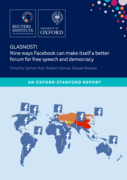
Glasnost! Nine Ways Facebook Can Make Itself a Better Forum for Free Speech and Democracy
Oxford: Reuters Institute for the Study of Journalism (2019), 27 pp.
"Following multiple controversies in the past two years, Facebook is seeking to implement much needed processes for self-regulation and governance to help regain the trust of the public, politicians, and regulatory authorities. Facebook has thus entered a new era of cautious glasnost, inviting resea
...
Digital Citizenship in a Datafied Society
Cambridge: Polity Press (2019), vii, 194 pp.
"Digitization has transformed the way we interact with our social, political and economic environments. While it has enhanced the potential for citizen agency, it has also enabled the collection and analysis of unprecedented amounts of personal data. This requires us to fundamentally rethink our und
...

A Global South Perspective on Alternative Spectrum Policy
Cape Town: Research ICT Africa (2019), 32 pp.
Social Media in Zimbabwe: A Toxic Tool or a Future Bridge to Peace?
Tokyo: Toda Peace Institute (2019), 10 pp.
"The rise of social media in Zimbabwe has brought with it a greater variety of platforms which offer people a means to express themselves. However, the democratisation of information and the increase in digital spaces have also come with greater state restriction and polarisation among Zimbabweans.
...