Filter
14
Topics
State Influence on the Media
6
Indirect Censorship, Soft Censorship
4
Media Concentration
3
Public Funding & Support Policies for Media
3
Media Law & Regulation
3
Financing Public Service Media
3
Access to Public Information, Freedom of Information, Right to Information
2
Government Advertising, State Advertising
2
Media Freedom, Press Freedom
2
Media Development Indicators
2
Diversity & Pluralism in Media / Communication
2
Media Capture, Vested Political & Other Interests in the Media
2
Communication & Media Indicators
2
Advertising Markets & Industries
1
Authoritarian Regimes: Government Communication Strategies
1
Media Markets
1
Media Market Transparency
1
Media Ownership
1
Political Economy of Media
1
Indigenous Communication
1
Media & Communication Policies
1
Language
Document type
Countries / Regions
Authors & Publishers
Media focus
Publication Years
Methods applied
Journals
Output Type
"[...] el libro propone un diálogo a partir de tres categorías, a saber: 1) las limitaciones al acceso a la información y sus impactos en la vida política; 2) el régimen jurídico de la comunicación; y 3) los medios de comunicación y la representación política. Esta perspectiva, nos ayuda a
...
Censorship, the Media, and the Market in China
Journal of Chinese Political Science, volume 25 (2020), pp. 285–309
"Pervasive media censorship in China is often seen as a strictly political issue. Although in past years reporters have had leeway to report on economic issues, the Chinese Party/state has moved to tamp down economic journalism, even arresting those who report on bad economic news. This shift brings
...

"2017 was marred by the assassination, in Malta, of the investigative journalist Daphne Caruana Galizia, an event which represented the darkest hour for media freedom and media pluralism in the European Union since the 2015 Charlie Hebdo massacre in France. This crime has profoundly shaken Europe an
...
Media Ownership Monitor Serbia
Reporters Without Borders (2017), 549 pp.
"The state has been for year the biggest advertiser in the country. Public money has been spent through its Ministries, institutions, republic agencies, bodies, local self-governments etc on different advertising and sponsorship contracts. The total value of state advertising still remains unknown d
...
Monitoring Media Pluralism in Europe: Testing and Implementation of the Media Pluralism Monitor 2015
"The Media Pluralism Monitor (MPM) is a tool for assessing the risks for media pluralism in a given country. The Monitor aims to help policymakers, researchers, and civil society to understand the threat to media pluralism in different media systems through research, analysis and the provision of co
...
State-Media Financial Relations in Serbia: A Transitional Year. Who Will Benefit from the Media Reforms?
Ljubljana: Peace Institute; South East European Media Observatory (2015), 15 pp.
"The outflow of money from state/public funds to the media has for years been unreasonable and non-transparent. Therefore, the ultimate goal of the ongoing media reforms is to introduce certain control and transparency through privatisation of state-owned media and introduce co-financing of media pr
...
State-Media Financial Relations in Bosnia and Herzegovina: Increasingly Dependent and Disciplined Media
Ljubljana: Peace Institute; South East European Media Observatory (2015), 20 pp.
"Particular political and business interests seem to overpower any notion of public interest in the financial relations between government and the media. The public interest that these financial patterns should in theory serve remains under-articulated and unmonitored with a lack of clear criteria,
...

State-Media Financial Relations in Albania: Nurturing Client-Based Media Practices
Ljubljana: Peace Institute; South East European Media Observatory (2015), 19 pp.
"The transparency of media market in Albania continues to be low, including both commercial operations and the state funding, despite of the existing databases. The involvement of new actors, such as advertising agencies, and sister companies of media outlets, makes it even more difficult to track s
...
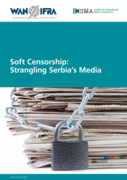
Soft Censorship: Strangling Serbia’s Media
Paris: World Association of Newspapers and News Publishers (WAN-IFRA) (2013), 29 pp.
"The mechanisms of state media funding in Serbia are used as indirect, and usually not easily visible, “soft censorship.” Soft censorship is used to promote positive coverage of - and to punish media outlets that criticize - officials or their actions. State funding of media is unregulated, unmo
...
Capturing Them Softly: Soft Censorship and State Capture in Hungarian Media
Paris: World Association of Newspapers and News Publishers (WAN-IFRA) (2013), 51 pp.
"State capture is slowly but surely enveloping Hungarian media, principally through the “soft censorship” of financial incentives and influence that affect media otlets’ editorial content and economic viability. Allocation of state advertising spending is opaque and unfair; it is based on the
...
Buying Compliance: Governmental Advertising and Soft Censorship in Mexico
Paris: World Association of Newspapers and News Publishers (WAN-IFRA) (2013), 47 pp.
"This report demonstrates the soft censorship and corrupting influence that unconstrained official advertising exerts on Mexico’s media. These practices negatively impact media quality, limit freedom of expression, violate the right to public information, and stifle public debate that is essential
...