Filter
6
Featured
Free Access
6
Inspiring Practice
1
Key Guidance
1
Top Insights
3
Topics
Gender-Based Online Harassment & Sexual Threats
4
Female Journalists & Media Workers
3
Cyberbullying, Cyberharassment
2
Chilling Effects (Discouragement of Legitimate Exercise of Legal Rights)
1
Harassment & Intimidation of Journalists
1
Hate Speech, Hate Speech in Social Media
1
Disinformation, Misinformation, Fake News
1
Countering Hate Speech, Disinformation & Propaganda
1
Health Disinformation & Misinformation
1
Countering Defamation & Harassment
1
COVID-19 Communication
1
Cadwalladr, Carole (British Investigative Journalist)
1
Ressa, Maria
1
Language
Document type
Countries / Regions
Authors & Publishers
Media focus
Publication Years
Methods applied
Output Type
The Chilling: Global Trends in Online Violence Against Women Journalists. Research Discussion Paper
Top Insights
UNESCO (2021), 94 pp.
"Online attacks on women journalists appear to be increasing significantly, as this study demonstrates, particularly in the context of the ‘shadow pandemic’ of violence against women during COVID-19. The pandemic has changed journalists’ working conditions, making them yet more dependent on di
...
The Chilling: Assessing Big Tech's Response to Online Violence Against Women Journalists
UNESCO (2021), 35 pp.
"This is an extracted chapter of a wider UNESCO-commissioned global study on online violence against women journalists produced by the Inter-national Center for Journalists (ICFJ). The full-length study will published in 2022. The chapter identifies the role of big tech companies and especially soci
...
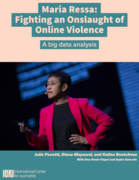
Maria Ressa: Fighting an Onslaught of Online Violence. A Big Data Analysis
Washington, DC: International Center for Journalists (ICFJ) (2021), 44 pp.
"This groundbreaking collaborative case study is the most comprehensive assessment of online violence against a prominent woman journalist to date. We conducted a forensic analysis of the torrent of social media attacks on internationally celebrated digital media pioneer Maria Ressa over a five-year
...
Online Violence Against Women Journalists: A Global Snapshot of Incidence and Impacts
Top Insights
Paris: UNESCO (2020), 17 pp.
"This report presents a snapshot of the first substantial findings from a global survey about online violence against women journalists conducted by UNESCO and the International Center for Journalists (ICFJ) in late 2020. Over 900 validated participants from 125 countries completed the survey in Ara
...
Disinfodemic: Deciphering COVID-19 Disinformation
Key Guidance
Paris: UNESCO (2020), 16 pp.
"COVID-19 disinformation creates confusion about medical science with immediate impact on every person on the planet, and upon whole societies. It is more toxic and more deadly than disinformation about other subjects. That is why this policy brief coins the term disinfodemic. Using this frame, the
...
Balancing Act: Countering Digital Disinformation While Respecting Freedom of Expression
Top Insights
Inspiring Practice
"[This publication] uses the term ‘disinformation’ to describe false or misleading content with potentially harmful consequences, irrespective of the underlying intentions or behaviours in producing and circulating such messages. The focus is not on definitions, but on how States, companies, ins
...