Filter
103
Featured
Free Access
26
Inspiring Practice
1
Top Insights
1
Topics
Journalists Dealing with Risks & Threats, Resilience & Wellbeing of Media Workers
91
Working Conditions of Journalists & Media Personnel
11
Journalism Education & Training
10
Conflict Reporting, Armed Conflict Reporting
8
Harassment & Intimidation of Journalists
4
Crime & Violence Reporting
4
Trauma: Media Representation & Reporting
4
War Reporting
4
Journalists: Professional Identity & Values
4
Disaster & Humanitarian Crisis Reporting
3
COVID-19 Pandemic: Effects on Journalism, Media & Communication
3
Crisis Communication
2
Genocides
2
Iraq War (2003)
2
Foreign Conflict Reporting, International War Reporting
2
Foreign Correspondents
2
Journalism
2
Freelance Journalists & Media Workers
2
Photojournalism
2
Audiences & Users
1
Audience Expectations & Satisfaction
1
Audience Orientation
1
Authoritarian Regimes: Government Communication Strategies
1
Indirect Censorship, Soft Censorship
1
Self-Censorship
1
Strategic Lawsuits Against Public Participation (SLAPP)
1
Extremism & Terrorism Reporting
1
Trauma, Coping with Trauma, Trauma Therapy
1
Violence in the Media
1
Digital Media Startups
1
Prisoners & Communication / Media
1
Earthquakes, Floods, Tsunamis, Natural Disasters
1
Climate Change Communication, Climate Journalism
1
Countering Defamation & Harassment
1
Journalism Ethics
1
Objectivity & Veracity of Reporting
1
Female Journalists & Media Workers
1
Mental Health (General)
1
Associations & Networks of Journalists
1
Investigative Journalism
1
Journalism Education Curricula
1
Journalism Studies & Research
1
Vox Pop Interviews
1
Journalistic Quality
1
Journalists
1
Labour Market for Journalists
1
Business & Economics Journalism
1
Court Reporting & Media Representation of Judicial System
1
Death & Grief: Reporting & Media Representation
1
Protests, Protest Movements, Protest Reporting & Media Representation
1
Television Journalism
1
Metaphors
1
Contracts, Labour Agreements, Service Contracts
1
Migration & Refugees Reporting & (Social) Media Representation
1
Conflict & War Photography
1
Media Capture, Vested Political & Other Interests in the Media
1
Memory, Memorizing
1
Interviewing (Journalistic Genre)
1
Resilience
1
User-Generated Contents
1
Language
Document type
Countries / Regions
Authors & Publishers
Media focus
Publication Years
Methods applied
Journals
Output Type
Taking to the streets: The effects of in-the-field harassment against journalists covering protests
Journalism, volume 25, issue 2 (2024), pp. 275-294
"Since 2017, 518 journalists have been attacked while covering protests (U.S. Press Freedom Tracker, 2021) which is one of the most dangerous places to be as a journalist in the United States (Sterne & Peters, 2017). Despite the volatile climate around journalists as they cover increasingly dangerou
...
“The goal is to make you weaker”: Mental well-being and risks among European cross-border investigative journalists
Journalism (2024), [no pag.]
"The increased scale of cross-border journalistic investigations brings about severe challenges: online harassment, physical violence, legal threats, but also emotional challenges and mental stress that can lead to burnout. The latter has never been the focus of studies on cross-border investigative
...
Predictors of psychological distress in frontline journalists: Common denominators across three decades of conflicts
Traumatology, volume 30, issue 3 (2024), pp. 306-313
"Objective: To determine risk factors for symptoms of PTSD and depression in frontline journalists that traverse type of conflict, degree of exposure to stressors, language, and culture. Methods: A retrospective analysis of 1,103 frontline journalists from 12 datasets (Balkans, 9/11 attacks, Iraq, M
...
Mental Health and Wellbeing for Journalists: A Practical Guide
Top Insights
London; New York: Routledge (2024), xiv, 185 pp.
"This book offers a first-of-its-kind practical, person-centred guide to managing and contextualising journalists’ emotional wellbeing and mental health. Drawing on the author’s experience as a storyteller, journalist, and media safety consultant, this book combines significant lived personal ex
...
Who Teaches About Hostility? Examining Factors for Inclusion in Journalism Curriculum
Journalism & Mass Communication Educator, volume 79, issue 2 (2024), pp. 205-223
"Journalistic well-being is garnering increasing attention from scholars globally. Nevertheless, minimal research has explored how colleges and universities are teaching about such topics, especially as they pertain to hostility toward the press, which is on the rise. Utilizing a survey of journalis
...
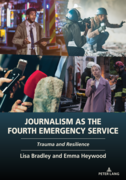
Journalism as the Fourth Emergency Service: Trauma and Resilience
Inspiring Practice
New York et al.: Peter Lang (2024), xviii, 257 pp.
"Journalists have often been considered the "fourth emergency service". They are first on the scene, alongside paramedics, fi re and police, running towards danger rather than away, and providing independent, veritable and crucial information in the public interest. And yet, unlike frontline workers
...
Psychological Aid and Training for Journalists Who Face Continued Emotionally Demanding Environments: The Case of Venezuelan Journalists
"Journalism, particularly in conflict reporting, poses significant emotional challenges, with journalists often grappling with post-traumatic stress disorder and other traumas. This research delves into the emotional dimensions of journalistic practice, examining journalists’ perspectives on menta
...
Safety of journalists: The symbolic violence and double burden of marginalized journalists
In: The Routledge Companion to Digital Journalism Studies
London; New York: Routledge (2024), 10 pp.
"Journalists have always worked amidst risks to their safety; risks that have become all the more exacerbated in the digital age. Scholarship has documented journalists confronting cyberattacks, various forms of harassment, verbal abuse and hate speech, as well as legal threats from a variety of act
...
Journalists and Exposure to Trauma: Exploring Perceptions of PTSD and Resilience Among Pakistan’s Conflict Reporters
Journalism Practice (2024), [no pag.]
"The study attempts to understand how Pakistani journalists perceive Post-Traumatic Stress Disorder (PTSD) and resilience in the wake of covering traumatic events. Qualitative interviews of 32 Pakistani journalists were conducted who had covered military operations against militants. The findings in
...
Effectiveness of art therapy in reducing post-traumatic stress disorder symptoms and the propensity to quit journalism among journalists covering banditry activities in Nigeria
Media, War & Conflict, volume 17, issue 4 (2024), pp. 445-462
"The goal of this study was to examine the efficacy of art therapy in the treatment of Post Traumatic Stress Disorder (PTSD) and the propensity to quit journalism among Nigerian journalists covering banditry attacks. The researchers utilized a quasi-experiment as the design for the study and sampled
...
Independent Online Journalists' Harassment and the Emotional Repercussions
"Communication the world over is a vital cog in communities. The sender and the receiver play different and complementary roles in information dissemination. Be that as it may, many contemporary information senders are faced with different forms of harassment. The advent of social media has seen a r
...
‘They blame the messenger’: Re-examining the critique of journalists reporting on genocide in Rwanda and Srebrenica
Journalism, volume 25, issue 10 (2024), pp. 2117–2134
"Reporting on cases of genocide presents distinct complexities and challenges for journalists, who must negotiate practical, professional, and emotional experiences that challenge traditional expectations of their role. Previous research has provided strident critiques of this reporting, arguing Wes
...

Embedding Trauma Literacy Into Curriculum: An Examination of the Attitudes of Australian and New Zealand Journalism Educators
Journalism & Mass Communication Educator, volume 78, issue 2 (2023), pp. 112-126
"Australia and New Zealand have reputations as countries prone to catastrophic and frequent natural and man-made disasters. Therefore, it is no surprise that antipodean academics want trauma-informed education for their journalism students. This study presents the Australian-New Zealand results of a
...
Terror without training: First-hand experiences of student journalists covering the 2019 Christchurch mosque shootings
Journal of Applied Journalism & Media Studies (2023), [no pag.]
"In 2019, 51 people were killed in terror attacks at two mosques in Christchurch, a city on the east coast of the South Island of New Zealand with a population of around 400,000 people. It was the deadliest mass shooting in the country’s history and the first terror attack of its kind on home soil
...
News, Negativity, and the Audience's Role in Finding Happiness in Journalism
"This commentary argues that caring about mental health and well-being in journalism begins with journalists, but it also should include corresponding care for news audiences." (Abstract)
“Living a lie at the workplace”: Ghanaian Media Practitioners’ understanding of emotional labour and response patterns
IFE PsychologIA, volume 31, issue 1 (2023), ?? pp.
"The authors saw the need to explore the emotional labour experiences of media practitioners owing to the sparse literature on the phenomenon from an African perspective. The study explored how media practitioners explain emotional labour, the factors that predispose them to emotional labour experie
...
“When can I get angry?” Journalists’ coping strategies and emotional management in hostile situations
Journalism, volume 25, issue 10 (2023), pp. 2099-2116
"Research shows that emotional management is often part of journalists’ decision-making in the news creation process and when dealing with attacks, insults, or harassment, which we describe by the umbrella term hostility. Some emotional management strategies can lead journalists to self-censorship
...
Preparing for Risks and Building Resilience
Journalism Studies, volume 24, issue 7 (2023), pp. 1008-1025
"Journalists confront terror and war to report and document what is happening. Covering traumatic events is dangerous for the reporters on the scene and may leave them with distress responses. The aim of this study is to investigate the coping strategies journalists use to deal with danger and traum
...
Workplace Happiness, Journalism and COVID-19 in South Asia
"This chapter explores some of the positive strategies employed by South Asian media institutions to enhance workplace happiness and help journalists to cope with stress and traumatic experiences during the COVID-19 pandemic. Happiness is crucial for media institutions because journalism is one of t
...
Self-Employment in the News Industry
"This chapter highlights the position of freelance or self-employed journalists in the news sector from the pessimistic observation that news organizations tend to push journalists into a freelance status to cope with decreasing revenues and are inspired by neoliberal thoughts." (Abstract)