Filter
8
Topics
Conflict Areas: Media Systems, Media Landscapes, Role of Media
2
Digital Activism, Cyber Advocacy
1
Authoritarian Regimes: Media Systems & Landscapes
1
Digital Media Censorship, Control & Filtering, Internet & Social Media Censorship
1
Censorship
1
Censorship Circumvention Tools & Strategies
1
Foreign Government Communication Interventions
1
Conflict Prevention, Mediation & Reconciliation: Role of Media
1
Conflict Reporting, Armed Conflict Reporting
1
Conflict-Sensitive Digital Technology Use & Social Media in Prevention & Transformation
1
Hate Speech, Hate Speech in Social Media
1
Media Assistance in Conflict Regions & Fragile Countries
1
Development Assistance
1
Digital Inclusion
1
Democratization & Digital Media / Social Media
1
Twitter & Microblogs
1
Digitalisation, Online Communication & Democracy / Democratization
1
Media Assistance: Country Strategies & Experiences
1
Media Landscapes, Media Systems, Media Situation in General
1
Accountability & Transparency
1
Influence of Media on Politics
1
Political Transition and Media
1
Taliban
1
Language
Document type
Countries / Regions
Authors & Publishers
Media focus
Publication Years
Output Type
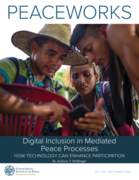
Digital Inclusion in Mediated Peace Processes: How Technology Can Enhance Participation
Washington, DC: United States Institute of Peace (USIP) (2020), 44 pp.
"Inclusion in peace processes is conventionally understood in “offline” terms, such as being physically present at the negotiation table. However, digital technology can support a mediator’s efforts to integrate a broad variety of perspectives, interests, and needs into a peace process. This r
...
The Need for a New US Information Strategy for North Korea
Washington, DC: United States Institute of Peace (USIP) (2019), 19 pp.
"Drawing on relevant literature, analysis of North Korean media and information control techniques, and interviews with refugees and defectors, this report argues that a new US information strategy is needed to alleviate the social isolation of the North Korean people and improve their long-term wel
...
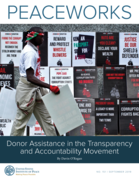
Donor Assistance in the Transparency and Accountability Movement
Washington, DC: United States Institute of Peace (USIP) (2019), 36 pp.
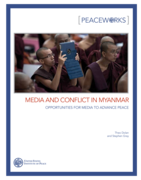
Media and Conflict in Myanmar: Opportunities for Media to Advance Peace
Washington, DC: United States Institute of Peace (USIP) (2014), 36 pp.
"This study is based on the Intended Outcomes Needs Assessment (IONA) methodology and assesses the changing relationships between media and conflict in Myanmar. Findings reveal a deeply rooted, intractable, and dynamic conflict landscape. Analysis focuses on three key conflicts: citizen-state, ethni
...
New Media and Conflict After the Arab Spring
Washington, DC: United States Institute of Peace (USIP) (2012), 24 pp.
"An extraordinary wave of popular protest swept the Arab world in 2011. Massive popular mobilization brought down long-ruling leaders in Tunisia and Egypt, helped spark bloody struggles in Bahrain, Libya, Syria, and Yemen, and fundamentally reshaped the nature of politics in the region. New media -
...
Afghanistan Media Assessment: Opportunities and Challenges for Peacebuilding
Washington, DC: United States Institute of Peace (USIP) (2010), 40 pp.
"International donor support for Afghanistan's media has had two primary goal The short-term goal has been to counteract the effects of insurgent communications in order to win the hearts and minds of the Afghan people. The long-term goal has been to create a free and independent media sector that w
...
Blogs and Bullets: New Media in Contentious Politics
Washington, DC: United States Institute of Peace (USIP) (2010), 31 pp.
"The impact of new media can be better understood through a framework that considers five levels of analysis: individual transformation, intergroup relations, collective action, regime policies, and external attention. New media have the potential to change how citizens think or act, mitigate or exa
...