Filter
201
Featured
Free Access
99
Key Guidance
1
Top Insights
2
Topics
Female Journalists & Media Workers
71
Self-Censorship
24
Safety of Journalists, Safety Risks of Media Workers
13
Journalists Dealing with Risks & Threats, Resilience & Wellbeing of Media Workers
12
Gender-Based Online Harassment & Sexual Threats
9
Cyberbullying, Cyberharassment
7
Media Freedom, Press Freedom
6
Countering Defamation & Harassment
6
Gender-Based Harassment, Intimidation & Violence
6
Safety of Journalists: Law & Public Policies
5
Press Freedom & Communication Rights Violations
4
Countering Hate Speech, Disinformation & Propaganda
4
Hate Speech, Hate Speech in Social Media
3
Media Law & Regulation
3
Chilling Effects (Discouragement of Legitimate Exercise of Legal Rights)
2
Impunity for Crimes Against Journalists & Media Personnel
2
Surveillance, Surveillance Technologies, Spyware
2
Russia-Ukraine War <2014-
2
Conflict Reporting, Armed Conflict Reporting
2
Sports Reporting
2
Foreign Correspondents
2
Protests, Protest Movements, Protest Reporting & Media Representation
2
Working Conditions of Journalists & Media Personnel
2
Authoritarian Regimes: Media Systems & Landscapes
1
Independent & Oppositional Media in Authoritarian Regimes
1
Cybersecurity, Digital Safety, Privacy, Right to Privacy
1
Digital Media Censorship, Control & Filtering, Internet & Social Media Censorship
1
Media / Communication Control
1
Censorship
1
Countering Press Freedom Violations by Legal Actions
1
Killings of Journalists & Media Personnel
1
Violence Against Journalists & Media Personnel
1
Alternative Communication & Media
1
Twitter & Microblogs
1
LGBT & Communication / Media
1
Minority Journalists
1
Disinformation, Misinformation, Fake News
1
Disinformation & Misinformation Law & Regulation
1
Self-Regulation of Media
1
Gender Representation & Stereotypes in the Media
1
Gender-Sensitive Journalism
1
Women's Rights
1
COVID-19 Communication
1
Indigenous Journalists & Communicators
1
Russia: Foreign Information Operations, International Broadcasting, Public Diplomacy
1
European Union (EU)
1
Associations & Networks of Journalists
1
Investigative Journalism
1
Journalism Education & Training
1
Local Television
1
COVID-19 Pandemic: Effects on Journalism, Media & Communication
1
Media Landscapes, Media Systems, Media Situation in General
1
Criminal Law & Criminal Prosecution
1
Human Rights Violations
1
Law Enforcement, Litigations, Legal Practice, Case Law, Jurisdiction
1
Legal Protection
1
Migration & Refugees Reporting & (Social) Media Representation
1
Hindu Nationalism
1
Democracy / Democratization and Media
1
Media Capture, Vested Political & Other Interests in the Media
1
Taliban
1
COVID-19 Pandemic: Economic, Political and Social Effects
1
Language
Document type
Countries / Regions
Authors & Publishers
Media focus
Publication Years
Methods applied
Journals
Output Type
Trolling Journalists and the Risks of Digital Publicity
Journalism Practice, volume 16, issue 5 (2020), pp. 984-1000
"The global phenomenon of trolling of journalists lays out the ambivalent consequences of news interactivity and the risks of digital publicity. The push for digital publicity made journalists more exposed to attacks amid rising digital hate and the populist demonization of the news media. The negat
...
You Really Have to Have a Thick Skin’: A Cross-Cultural Perspective on How Online Harassment Influences Female Journalists
Journalism, volume 21, issue 7 (2020), pp. 877-895
"In-depth interviews with 75 female journalists who work or have worked in Germany, India, Taiwan, the United Kingdom, and the United States of America reveal that they face rampant online gendered harassment that influences how they do their jobs. Many of the women report that if they aim to engage
...
Constructing Silence: Processes of Journalistic (Self-)Censorship during Memoranda in Greece, Cyprus, and Spain
Media and Communication, volume 8, issue 1 (2020), pp. 15-26
"What are to be considered as threats against journalism? Whereas the literature on safety of journalists mainly discusses threats as part of armed conflicts, this article studies how other kinds of conflicts such as economic strangulation and the viability threat represent threats against journalis
...

Pushing a Political Agenda: Harassment of French and African Journalists in Côte d’Ivoire’s 2010-2011 National Election Crisis
International Journal of Communication, volume 14 (2020), pp. 472-490
"Côte d’Ivoire’s national election in 2010 descended into civil war into 2011 when incumbent President Laurent Gbagbo refused to concede the presidency to the internationally recognized winner Alassane Ouattara. The three political players in this election—the parties of Ouattara, Gbagbo, and
...
Work-related sexual harassment and coping techniques: The case of Indonesian female journalists
Media Asia, volume 47, issue 1-2 (2020), pp. 23-33
"Female journalists make up only between five to 10 percent of the total journalists in Indonesia. Consequently, this often gives women little bargaining power in the workplace. This research analyzes the prevalence and nature of sexual harassment experienced by Indonesian female journalists, as wel
...

Strengthening Media Freedom: The Protection of Journalists in Europe, Hate Speech, Disinformation and the Role of Platforms
European Parliament (2020), 20 pp.
"European Parliament resolution of 25 November 2020 on strengthening media freedom: the protection of journalists in Europe, hate speech, disinformation and the role of platforms (2020/2009(INI))." (Introduction)
Double-edged knife: Practices and perceptions of technology and digital security among Mexican journalists in violent contexts
Tapuya: Latin American Science, Technology and Society, volume 3, issue 1 (2020), pp. 22-42
"Violence against Mexican journalists has received significant attention from scholars at home and abroad during the last decade. However, though a diversity of issues have been consistently studied, there is one topic that is still largely neglected: the implications of technology for news workersâ
...

A way to silence journalists? Estonian female journalists’ experiences with harassment and self-censorship
"The aim of the study is to investigate Estonian female journalists’ experiences with harassment resulting in self-censorship. We carried out three studies: one in 2015, a second in 2016 and a third one in 2018. The data were gathered by in-depth interviews (2015 and 2018), journalists’ diaries
...
Talking Back: Journalists Defending Attacks Against Their Profession in the Trump Era
Journalism Studies, volume 21, issue 11 (2020), pp. 1496–1513
"According to neo-institutional theory, the survival of institutions in society is predicated on a cultural discourse. Dubbed “the institutional myth,” this discourse reflects the core values, practices and aspirations of an institution and legitimizes its existence to internal and external stak
...
"In the middle of a global pandemic, as a wave of anti-racism activism sweeps the nation, conditions are rife for a spike in online hate and harassment. Tens of thousands have taken to the streets to protest police brutality while millions more socially distance at home, anxious and isolated, with e
...
Freedom of Expression in Times of Covid-19: Chilling Effect in Hungary and Serbia
Journal of Liberty and International Affairs, volume 6, issue 2 (2020), pp. 14-29
"New technologies have opened several risks to safety of journalists. More importantly, in the state of emergency caused by the Covid-19 outbreak, journalists and media actors have shifted their activities online more than ever, which also made them more prone to digital threats and attacks. In some
...
A Badge of Honor? How the New York Times Discredits President Trump’s Fake News Accusations
Journalism Studies, volume 20, issue 2 (2019), pp. 287-304
"News organizations in many Western democracies face decreasing trust amid fake news accusations. In this situation, news organizations risk losing their license to operate and need to defend their legitimacy. This study analyzes how The New York Times (NYT) discredits fake news accusations, which a
...
State-Aligned Trolling in Iran and the Double-Edged Affordances of Instagram
New Media & Society, volume 21, issue 7 (2019), pp. 1506-1527
"Online harassment is increasingly applied as a form of information control to curb free speech and exert power in online public spheres. In recent years, states have appeared to be particularly invested in weaponizing information against dissidents in an attempt at dominating social and political d
...
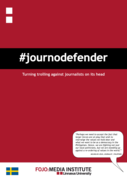
#journodefender: Turning Trolling Against Journalists on its Head
Kalmar: Fojo Media Institute (2019), 83 pp.
"This report describes and analyses how online propaganda against journalists across the world - through hate, harassment, threats and fabricated news – undermines independent reporting, sows doubt among the public and makes journalists, in particular female journalists, open for online attacks an
...
3rd International Press Freedom Seminar: Off/Online Intimidation of Journalists. Report
Ghent: Ghent University (2019), 6 pp.
"The annual International Press Freedom was, for the third time, organised by the Faculty of Law and Criminology and the Faculty of Political and Social Sciences of Ghent University, Belgium. The seminar gathered speakers from different backgrounds: journalists, academics, and civil society organisa
...
Fighting Words: Journalism Under Assault in Central and Eastern Europe
Oxford: Reuters Institute for the Study of Journalism (2019), 30 pp.
"To understand the situation and examine what can be done to address it, we sent out a questionnaire to journalists in 16 countries in the region, asking them about the state of press freedom and the areas in which they felt their ability to work was being curtailed.We also asked them about sources
...

Journalistic practices on the professional safety among journalists in Oyo State
International Journal of Research and Scholarly Communication, volume 1, issue 4 (2018), pp. 43-59
"Journalists' safety as well as media workers has become a subject of discussion on press freedom and the working condition of reporters following dangerous development on the media scene which has become a preoccupation with journalism professional bodies. As such, in order to achieve the objective
...

Module 7. Combatting online abuse: When journalists and their sources are targeted
In: Journalism, ‘Fake News’ & Disinformation: Handbook for Journalism Education and Training
Paris: UNESCO (2018), pp. 115-127
"The problem of disinformation and misinformation undermining credible journalism and reliable information has escalated dramatically in the social media era. Consequences include the deliberate targeting of journalists and other online publishers, along with their sources, who are seeking to verify
...
Local-Level Authoritarianism, Democratic Normative Aspirations, and Antipress Harassment: Predictors of Threats to Journalists in Mexico
International Journal of Press/Politics, volume 23, issue 4 (2018), pp. 539-560
"Cross-national research has identified crime, corruption, and human rights abuses as explanations for threats against journalists in democracies and authoritarian hybrids plagued by antipress violence. In-depth studies additionally suggest gender or occupational characteristics such as risky newsbe
...