Filter
201
Featured
Free Access
99
Key Guidance
1
Top Insights
2
Topics
Female Journalists & Media Workers
71
Self-Censorship
24
Safety of Journalists, Safety Risks of Media Workers
13
Journalists Dealing with Risks & Threats, Resilience & Wellbeing of Media Workers
12
Gender-Based Online Harassment & Sexual Threats
9
Cyberbullying, Cyberharassment
7
Media Freedom, Press Freedom
6
Countering Defamation & Harassment
6
Gender-Based Harassment, Intimidation & Violence
6
Safety of Journalists: Law & Public Policies
5
Press Freedom & Communication Rights Violations
4
Countering Hate Speech, Disinformation & Propaganda
4
Hate Speech, Hate Speech in Social Media
3
Media Law & Regulation
3
Chilling Effects (Discouragement of Legitimate Exercise of Legal Rights)
2
Impunity for Crimes Against Journalists & Media Personnel
2
Surveillance, Surveillance Technologies, Spyware
2
Russia-Ukraine War <2014-
2
Conflict Reporting, Armed Conflict Reporting
2
Sports Reporting
2
Foreign Correspondents
2
Protests, Protest Movements, Protest Reporting & Media Representation
2
Working Conditions of Journalists & Media Personnel
2
Authoritarian Regimes: Media Systems & Landscapes
1
Independent & Oppositional Media in Authoritarian Regimes
1
Cybersecurity, Digital Safety, Privacy, Right to Privacy
1
Digital Media Censorship, Control & Filtering, Internet & Social Media Censorship
1
Media / Communication Control
1
Censorship
1
Countering Press Freedom Violations by Legal Actions
1
Killings of Journalists & Media Personnel
1
Violence Against Journalists & Media Personnel
1
Alternative Communication & Media
1
Twitter & Microblogs
1
LGBT & Communication / Media
1
Minority Journalists
1
Disinformation, Misinformation, Fake News
1
Disinformation & Misinformation Law & Regulation
1
Self-Regulation of Media
1
Gender Representation & Stereotypes in the Media
1
Gender-Sensitive Journalism
1
Women's Rights
1
COVID-19 Communication
1
Indigenous Journalists & Communicators
1
Russia: Foreign Information Operations, International Broadcasting, Public Diplomacy
1
European Union (EU)
1
Associations & Networks of Journalists
1
Investigative Journalism
1
Journalism Education & Training
1
Local Television
1
COVID-19 Pandemic: Effects on Journalism, Media & Communication
1
Media Landscapes, Media Systems, Media Situation in General
1
Criminal Law & Criminal Prosecution
1
Human Rights Violations
1
Law Enforcement, Litigations, Legal Practice, Case Law, Jurisdiction
1
Legal Protection
1
Migration & Refugees Reporting & (Social) Media Representation
1
Hindu Nationalism
1
Democracy / Democratization and Media
1
Media Capture, Vested Political & Other Interests in the Media
1
Taliban
1
COVID-19 Pandemic: Economic, Political and Social Effects
1
Language
Document type
Countries / Regions
Authors & Publishers
Media focus
Publication Years
Methods applied
Journals
Output Type


Modelling the impact of safety threats on professional journalistic reporting of protests by Indigenous People of Biafra among Nigerian journalists
Journal of International Communication, volume 29, issue 2 (2023), pp. 234-252
"This study aimed to determine the impact of safety challenges on professional journalistic reporting of IPOB protests in Nigeria. A total of 400 Nigerian journalists who were covering IPOB activities were surveyed. Data were analysed using multivariate analysis of variance (MANOVA), multivariate an
...
The growing norm of sexual harassment in Pakistan’s mainstream and ethnic news media
Media Asia, volume 50, issue 3 (2023), pp. 397-417
"Across time, in a variety of forms and spaces -from homes and workplaces to digital domains of social media- women have become victims of sexual harassment. Over the last couple of years, the world has witnessed appalling cases followed under the #MeToo campaign that has inspired an increasing numb
...
Twitter trolling of Pakistani female journalists: A patriarchal society glance
Media, Culture & Society, volume 45, issue 6 (2023), pp. 1303-1314
"The incorporation of new media technology into journalistic practices led to online harassment, particularly of female journalists. The researchers investigated the tweets of four prominent Pakistani female journalists through the lens of post-colonial feminism and symbolic violence. The qualitativ
...
Online Harassment and Trolling of Political Journalists in Pakistan
Journalism Practice (2023), [no pag.]
"This study examines the online harassment faced by political journalists in Pakistan on Twitter, specifically focusing on the actions of users affiliated with various political parties. By selecting the 12 most active journalists on Twitter, we combined both content and textual analyses to examine
...
“Not Their Fault, but Their Problem”: Organizational Responses to the Online Harassment of Journalists
Journalism Practice, volume 17, issue 4 (2023), pp. 859-874
"Journalists are increasingly reporting that online harassment has become a common feature of their working lives, contributing to experiences of fatigue, anxiety and disconnection from social media as well as their profession. Drawing on interviews with American newsworkers, this study finds at lea
...
“You can Run, but You Cannot Hide!” Mapping Journalists’ Experiences With Hostility in Personal, Organizational, and Professional Domains
Journalism & Mass Communication Educator, volume 78, issue 2 (2023), pp. 199–213
"Our study describes how hostility reaches journalists and their reactions to the experiences. Semi-structured interviews with 18 Estonian journalists were conducted in 2021 from June to December. We divided journalists’ experiences into personal, professional, and organizational domains. One key
...
Harassment’s Toll on Democracy: The Effects of Harassment Towards US Journalists
Journalism Practice, volume 17, issue 8 (2023), pp. 1607-1626
"Journalists in democratically “free” countries have faced harassment from those external to the newsroom for decades, though that has recently increased in the United States by many accounts. To assess the effects of such harassment in the United States, 32 journalists were interviewed and more
...
A Decolonial Analysis of the Cyberbullying of South African Women Journalists
In: Decolonising Journalism Education in South Africa: Critical Perspectives
London; New York: Routledge (2023), pp. 135-148
"At the heart of decolonial theory is the love for woman, particularly black woman, as the most oppressed of political categories in the old colonial structures of race, class and gender hierarchy. This chapter uses decolonial theory, specifically Chela Sandoval’s concept of ‘decolonial love’
...
Occupational Hazards: Individual and Professional Factors of Why Journalists Become Victims of Online Hate Speech
Journalism Studies, volume 24, issue 7 (2023), pp. 838-856
"Journalists are regularly exposed to online hate speech their profession. Because discrimination often harms targets and can prompt self-censorship in journalistic content, undermining journalism’s public duty, it is essential to understand factors explaining why journalists become victims of onl
...
Harassed and Hushed: Bangladeshi Women Journalists’ Experiences of Gender Discrimination and Sexual Harassments
Athens Journal of Mass Media and Communications, volume 9, issue 3 (2023), pp. 185-202
"A large number of Bangladeshi women journalists are facing gender discrimination and sexual harassment in the workplace. This is one of the contributing factors in excluding women journalists’ voices from the public sphere. Drawing on the feminist approach of structure and agency theory, the stud
...
Conceptualizing Journalists’ Safety around the Globe
Digital Journalism, volume 11, issue 7 (2023), pp. 1211-1229
"Killings, as the most extreme form of violence against journalists, receive considerable attention, but journalists experience a variety of threats from surveillance to gendered cyber targeting and hate speech, or even the intentional deprivation of their financial basis. This article provides a co
...

Swedish journalists' perceptions of legal protection against unlawful online harassment
Frontiers in Sociology, volume 8, issue 1154495 (2023), 12 pp.
"This study examined journalists' perceptions regarding the legal system's ability to protect them against online harassment. By utilizing open-ended survey responses from respondents with varying levels of trust in the legal system, the findings suggested a need for increased technical proficiency,
...
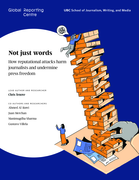
Not just words: How reputational attacks harm journalists and undermine press freedom
Top Insights
Vancouver: Global Reporting Centre; University of British Columbia School of Journalism, Writing, and Media (2023), 105 pp.
"Journalists’ reputations are under assault around the world. Among journalists we surveyed, 63% reported at least monthly attacks on their individual reputations — and 19% reported facing them daily. Rates were even higher for attacks on the reputations of their news outlets or the broader news
...
Social media and online hostility: Experiences of women in Irish journalism
Dublin: Irish Research Council; Dublin City University (2023), 60 pp.
"The public’s increased access to journalists via social networks is arguably the defining shift in audience-media relations over the past two decades. While some laud this potential for dialogue, the reality is that many journalists face targeted hostility, with women often subjected to particula
...

The “Price You Pay” and the “Badge of Honor”: Journalists, Gender, and Harassment
Journalism & Mass Communication Quarterly, volume 100, issue 1 (2023), pp. 193–213
"This article utilizes theoretical concepts of sensemaking and affective events theory to analyze and interpret what type of harassment events journalists experience from readers, viewers, and strangers, and their subsequent emotional responses. Findings indicated journalists experience three forms
...
Hate Speech on Social Media: A Global Approach
Covilhã (PO); Qutio (EC): LabCom; University of Beira Interior; PUCE Publications Centre (2023), 302 pp.
"Hate speech is more complex and diverse on social media. It spreads at high speed and can impact behaviors beyond the borders where it originates. Hate is ubiquitous, interactive, and multimedia. It is available 24/7, reaching a much larger audience. On social media, haters can be anonymous and fin
...
Hostility Toward the Press: A Synthesis of Terms, Research, and Future Directions in Examining Harassment of Journalists
Digital Journalism, volume 11, issue 7 (2023), pp. 1230-1249
"While there is an upsurge of research examining hostility toward the press from those external to the newsroom, there continues to be a lack of critical and robust theoretical foundation and agenda for such inquiry in countries considered to have a democratically free press. Therefore, the objectiv
...

Egypt’s #MeToo Moment: Using Social Media to Help Address Violence Against Women in Egypt
In: Violence Against Women in the Global South: Reporting in the #MeToo Era
Cham: Palgrave Macmillan (2023), pp. 173-199
"Adjusting the focus to the time and research of the present, this chapter analyzes two case studies that occurred before and after the revitalization of the global #MeToo movement in 2017. The selected cases investigate how women have used social media platforms to combat VAW. The first case is Daf
...