Filter
35
Featured
Free Access
34
Key Guidance
1
Quick Overview
1
Top Insights
1
Topics
Health Campaigns: Planning & Implementation
8
Health Communication
5
Tuberculosis Communication
5
Emergency Health Communication
4
Infectious Diseases' Outbreak Communication
4
Health Disinformation & Misinformation
4
Health Campaigns: Monitoring & Evaluation
4
COVID-19 Communication
4
Vaccination Campaigns & Vaccine Hesitancy
4
Advocacy
3
Disaster Risk & Preparedness Communication, Disaster Prevention Communication
3
Health Journalism
3
Child Protection, Protection of Minors
2
Crisis Communication
2
Disaster & Humanitarian Crisis Information Management
2
Countering Hate Speech, Disinformation & Propaganda
2
Good Practice Examples
2
Alcohol Abuse: Prevention & Media Representation
2
Polio Communication
2
Suicide Reporting & Media Representation
2
Science Communication & Research Dissemination
2
Radio Spots
1
Advocacy Campaigns
1
Campaigning
1
Child Abuse: Digital Media
1
Child Protection Online
1
Crime & Violence Reporting
1
Digital Healthcare & Information, Mobile Health, E-Health, Telemedicine
1
Early Warning: Disasters
1
Trust Building in Health & Emergency Communication
1
Teaching & Teaching Methods
1
Child Health, Mother & Child Care Communication
1
Food / Nutrition Communication & Media Representation
1
Health Campaigns: Message Design
1
Health Communication in Social Media, User-Generated Contents
1
Health Radio Programmes
1
COVID-19 Pandemic: Effects on Journalism, Media & Communication
1
Research Report Writing
1
Domestic Violence
1
Sexual Violence & Abuse, Rape
1
COVID-19 Pandemic: Economic, Political and Social Effects
1
Language
Document type
Countries / Regions
Authors & Publishers
Media focus
Publication Years
Output Type
Antimicrobial resistance: Toolkit for media engagement
Geneva: World Health Organization (WHO); FAO; United Nations Environment Programme (UNEP) (2024), vii, 40 pp.
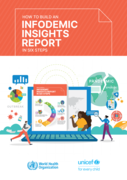
How to Build an Infodemic Insights Report in Six Steps
World Health Organization (WHO); UNICEF (2023), v, 73 pp.
"This manual provides a quick overview of the steps required to develop an infodemic insights report that can be used during an emergency response or for routine health programming (where so-called low-level infodemics may be more common). The steps are: 1. Choose the question that infodemic managem
...

Vaccine Crisis Communication Manual: A Step-By-Step Guidance for National Immunization Programmes
Copenhagen: World Health Organization (WHO) (2022), iv, 25 pp.
"This document provides immunization programmes and other stakeholders with step-by-step guidance on how to effectively manage the communication response to vaccine-related events, particularly those with a potentially high impact on public trust, which are therefore considered to be a vaccine crisi
...

Risk Communication and Community Engagement Approaches During the Monkeypox Outbreak in Europe, 2022
World Health Organization (WHO) (2022), 11 pp.
"This document is intended for health authorities designing RCCE interventions in the context of the current monkeypox outbreak in Europe. It supplements the ‘Interim advice on Risk Communication and Community Engagement during the monkeypox outbreak in Europe, 2022’ jointly published by ECDC an
...
Risk Communication and Community Engagement: A Compendium of Case Studies in Times of COVID-19
Copenhagen: World Health Organization (WHO) (2022), ix, 104 pp.
"This collection of case studies on risk communication and community engagement (RCCE) from 18 different country/ area level public health partners in the WHO European Region provides evidence of numerous results achieved and lessons learned since the start of the COVID-19 pandemic. RCCE has not tra
...
Advancing Infodemic Management in Risk Communication and Community Engagement in the WHO European Region: Implementation Guidance
Copenhagen: World Health Organization (WHO) (2022), vi, 65 pp.
"This guidance is based on the latest evidence and practical experience with IM in the WHO European Region and is designed to provide stakeholders with operational support for IM preparedness, readiness and response in public health emergencies. The intended readership is mainly response authorities
...

What Works to Prevent Online Violence Against Children? Executive Summary
Quick Overview
Geneva: World Health Organization (WHO) (2022), vi, 22 pp.
"The key messages that can be drawn from the evidence gathered as part of this review may be summarized as follows: resources should be confidently and generously committed to child and youth safety education programmes that have content that addresses online VAC and related topics; priority should
...
Reporting on Violence Against Children: A Guide for Journalists
Geneva: World Health Organization (WHO) (2022), vi, 28 pp.
Implementation Research Toolkit: IR-Related Communications and Advocacy
World Health Organization (WHO) (2021), 26 pp.
"Implementation Research (IR)-related communications and advocacy range from productive dialogue and engagement throughout research planning and implementation, through to translation and sharing of results through broad-based advocacy or awareness-raising materials, and ultimately to the uptake and
...
WHO Public Health Research Agenda for Managing Infodemics
Geneva: World Health Organization (WHO) (2021), xii, 53 pp.
"The five research streams are listed below. For each stream, three top research questions were identified, resulting in a list of 15 top priority research questions for the public health research agenda for infodemic management. Further, we listed for each subcategory a second tier of important res
...
"COVID-19 has prompted widespread school closures and physical distancing measures and made online platforms and communities essential to maintaining a sense of normalcy. Children and their families are turning to digital solutions more than ever to support children’s learning, socialization and p
...
COVID-19: Global Risk Communication and Community Engagement Strategy. Interim Guidance December 2020 — May 2021
Top Insights
World Health Organization (WHO) (2020), 46 pp.
"There is an unprecedented need to elevate the role risk communication and community engagement (RCCE) plays in breaking the chains of transmission and mitigating the impact of the pandemic. A revised RCCE strategy was needed to reflect this and the learning from the response to-date. The new strate
...
Communicating Risk in Public Health Emergencies: A WHO Guideline for Emergency Risk Communication (ERC) Policy and Practice
World Health Organization (WHO) (2017), xi, 57 pp.
"The recommendations in these guidelines provide overarching, evidence-based guidance on how risk communication should be practised in an emergency. The recommendations also guide countries on building capacity for communicating risk during health emergencies. Specific step-by-step instructions are
...
WHO Strategic Communications Framework for Effective Communication
Geneva: World Health Organization (WHO) (2017), ii, 52 pp.
Preventing Suicide: A Resource for Media Professionals
Key Guidance
World Health Organization (WHO), updated ed. (2017), viii, 18 pp.
"This resource booklet briefly summarizes the current evidence on the impact of media reporting of suicide, and provides information for media professionals about how to report on suicide, recognizing that there are times when a suicide will need to be reported on the grounds of its newsworthiness.
...