Filter
60
Featured
Free Access
56
Key Guidance
1
Topics
Evaluation Methods, Evaluation Tools
7
Organisational Development & Capacity Building
7
Advocacy & Empowerment: Monitoring & Evaluation
6
Evaluation Approaches, Purposes & Frameworks
5
Monitoring
5
Impact Assessment & Outcome Evaluation
4
Organisational Development & Capacity Building: Evaluation, Monitoring, Impact Assessment
3
Participatory, Collaborative & Empowerment Evaluation
3
Nonprofit Organizations, NGOs
2
Development Assistance: Evaluation, Monitoring, Impact Assessment
2
Strategy Development & Strategic Planning
2
Indicators & Indices
2
Randomised Control Trials & (Quasi-) Experimental Designs
2
Theories of Change
2
Advocacy & Empowerment: Experiences
1
Advocacy & Empowerment: Planning & Implementation
1
Campaigning: Planning & Implementation
1
Educational Films & Videos
1
Religion and Justice / Peace / Reconciliation
1
Cultural Cooperation (Development Aid)
1
Cultural Exchange
1
Culture (General)
1
Church Development Cooperation
1
Development Assistance: Institutional Support & Core Funding
1
Development Programmes
1
Donor NGOs
1
Religion and Development
1
Local Church Development Work
1
Media Didactics, Media Use in Education
1
Workshops & Seminars: Methods, Tools, Planning, Experiences
1
Evaluation
1
Developmental Evaluation (Informing the Development & Ongoing Adaptation of an Initiative)
1
Evaluation Design & Implementation
1
Evaluation: Training
1
Gender in Evaluation, Monitoring, Impact Assessment
1
Most Significant Change (MSC)
1
Outcome Harvesting (Evaluation Methodology)
1
Utilisation-Focused Evaluation (Focus on Intended Use by Intended User)
1
Associations
1
HIV / AIDS (General)
1
Accounting, Controlling, Financial Reporting
1
Leadership, Leadership Development
1
Organisational Assessment
1
Project Design, Project Planning
1
Project Financing
1
Religion and Politics
1
Network Analysis
1
Qualitative Analysis
1
Comparative Approaches & Methods in Communication Research
1
Data Collection, Data Collection Methods
1
Information Analysis
1
Focus Groups & Group Discussions (Qualitative Research Method)
1
Interviewing (Qualitative Research Method)
1
Questionnaires, Questionnaire Design
1
Sampling (Survey Methodologies, Statistics)
1
Survey Methods
1
Visual Research Methods (Photography, Video et al.)
1
Secondary Data Sources
1
Networks & Networking
1
Social Development
1
Language
Document type
Countries / Regions
Authors & Publishers
Media focus
Publication Years
Output Type
M&E of Advocacy
INTRAC (2020), 6 pp.
"Monitoring and evaluating advocacy work involves unique challenges. These can usually be overcome provided expectations are realistic. Ongoing monitoring and evaluation carried out during advocacy interventions should enhance and support real-time decision-making. Advocacy evaluations should includ
...

Aggregation and Summarisation
INTRAC (2019), 7 pp.
"CSOs sometimes need to summarise or aggregate information across multiple interventions. This can be a difficult and challenging task, especially for large non-governmental organisations (NGOs) working in many different countries and/or sectors. Summarisation and aggregation can be achieved through
...
Indicators
INTRAC (2017), 4 pp.
"Indicators are commonly used in social development to provide evidence of change. They form an important part of most monitoring and evaluation systems and approaches. There are many different types of indicator, including quantitative and qualitative indicators. They can be developed in different
...

Utilisation-Focused Evaluation
INTRAC (2017), 2 pp.
"Utilisation-focused evaluations (UFEs) are based on the principle that an evaluation should be judged according to how useful it is. UFEs should be planned and implemented in a way that increases the likelihood of the findings being used. This normally means identifying the primary users of an eval
...

Theory of Change
INTRAC (2017), 4 pp.
"A Theory of Change approach to planning and evaluation is increasingly being considered essential practice within social development. Theories of Change can be developed in many ways. Common elements include an articulation of how change happens in a particular context, clarification of an organisa
...

Developmental Evaluation
INTRAC (2017), 3 pp.
"Developmental evaluation involves long-term relationships between evaluators and project or programme staff. Evaluation is ongoing, which means that feedback can be provided on a continuous basis. Development evaluation is particularly appropriate for projects or programmes working in complex or un
...

Real-Time Evaluation
INTRAC (2017), 3 pp.
"A real-time evaluation (RTE) is designed to provide immediate (real time) feedback to those planning or implementing a project or programme, so that they can make improvements. This feedback is usually provided during the evaluation field work, rather than afterwards. RTEs are normally associated w
...

Participatory Evaluation
INTRAC (2017), 3 pp.
"A participatory evaluation actively involves key stakeholders, especially the intended beneficiaries of a project or programme, in the design and implementation of the evaluation. Participatory evaluations can be carried out for many reasons. The two most common are to empower beneficiaries to bett
...
Programme Indicators
INTRAC (2017), 4 pp.
"Some programme indicators are designed to be collected at programme level. Others are designed to capture, summarise or aggregate information collected at project or partner level. It is important to clarify how information on indicators is transmitted between different levels of a programme." (Int
...

"To understand the changes brought about by a project or programme it is first necessary to understand what the original situation was. This is known as the baseline. Baselines can range from simple data collection exercises through to large, expensive surveys. They are an important part of many M&E
...
Focus Group Discussions
INTRAC (2017), 3 pp.
"Focus group discussions are facilitated discussions, held with a small group of people who have specialist knowledge or interest in a particular topic. They are used to find out the perceptions and attitudes of a defined group of people. Focus group discussions can be applied at any stage of the pr
...

Interviews
INTRAC (2017), 4 pp.
"Interviews are routinely carried out when projects and programmes are planned, monitored or evaluated. Interviews may be carried out face-to-face or through remote media. They may be carried out with individuals or groups. They may be unstructured, semi-structured or structured. And they may be inf
...
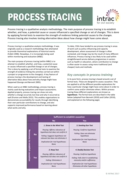
Process Tracing
INTRAC (2017), 5 pp.
"Process tracing is a qualitative analysis methodology. The main purpose of process tracing is to establish whether, and how, a potential cause or causes influenced a specified change or set of changes. This is done by applying formal tests to examine the strength of evidence linking potential cause
...
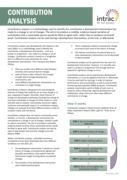
Contribution Analysis
INTRAC (2017), 4 pp.
"Contribution analysis is a methodology used to identify the contribution a development intervention has made to a change or set of changes. The aim is to produce a credible, evidence-based narrative of contribution that a reasonable person would be likely to agree with, rather than to produce concl
...

Secondary Data Sources
INTRAC (2017), 2 pp.
"Sometimes, information is used for planning, monitoring or evaluation that has previously been collected by other people or organisations for their own purposes. This is known as secondary data. There are many potential sources of secondary data. Secondary data can be used at any stage of a project
...

Impact Grids
INTRAC (2017), 3 pp.
"An impact grid is a tool that helps stakeholders involved in a development intervention to analyse multiple changes by mapping those changes onto a grid. A typical grid charts the extent of change alongside the degree of contribution of the intervention. Impact grids can be used for many different
...
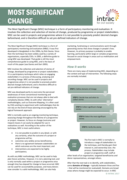
Most Significant Change
INTRAC (2017), 4 pp.
"The Most Significant Change (MSC) technique is a form of participatory monitoring and evaluation. It involves the collection and selection of stories of change, produced by programme or project stakeholders. MSC can be used in projects and programmes where it is not possible to precisely predict de
...

Gender-Responsive Evaluation
INTRAC (2017), 3 pp.
"A gender-responsive evaluation includes two main components. It assesses the degree to which gender and power relationships change as a result of an intervention. And it ensures that women’s voices are prominent throughout the evaluation. Gender-responsive evaluations can be used to evaluate any
...

Randomised Control Trials
INTRAC (2017), 6 pp.
"In a Randomised Control Trial (RCT) different units are randomly assigned to separate groups. One group receives a development intervention and the other does not. Changes in the two groups over time are then compared to accurately measure the effect of the intervention. RCTs have been much debated
...

Types of Evaluation
INTRAC (2017), 4 pp.
"There are many different types of evaluation. Each type has its own set of processes and/or principles. Many factors influence decisions over what type of evaluation to use. Evaluations can be categorised according to their purpose, who conducts them, when they are carried out, the broad approach u
...