Filter
14
Topics
Journalists Dealing with Risks & Threats, Resilience & Wellbeing of Media Workers
14
Conflict Reporting, Armed Conflict Reporting
4
Foreign Conflict Reporting, International War Reporting
2
Foreign Correspondents
2
Migration & Refugees Reporting & (Social) Media Representation
2
Iraq War (2003)
1
Violence in the Media
1
War Reporting
1
User-Generated Contents
1
Language
Document type
Countries / Regions
Authors & Publishers
Media focus
Publication Years
Methods applied
Journals
Output Type
The emotional well-being of journalists exposed to traumatic events: A mapping review
Media, War & Conflict, volume 14, issue 4 (2021), pp. 476–502
"This article presents a mapping review of the available literature on the emotional well-being of journalists exposed to traumatic events. The review consists of three parts: (a) a summary of the results of trauma-related literature; (b) identification of the limitations of studies to date; and (c)
...
Psychological distress in Afghan journalists: A descriptive study
Journal of Aggression, Conflict and Peace Research, volume 2, issue 3 (2020), pp. 115-123
"Afghanistan is one of the world’s most dangerous places for journalists. There are, however, no data on the mental health of Afghan journalists covering conflict in their country. The study aims to determine the degree to which Afghan journalists are exposed to traumatic events, their perceptions
...
Journalists covering the refugee and migration crisis are affected by moral injury not PTSD
Journal of the Royal Society of Medicine Open, volume 9, issue 3 (2018), pp. 1-7
"Objective: To explore the emotional health of journalists covering the migrations of refugees across Europe. Design: Descriptive. A secure website was established and participants were given their unique identifying number and password to access the site. Setting: Newsrooms and in the field. Partic
...

Symptoms of PTSD in Frontline Journalists: A Retrospective Examination of 18 Years of War and Conflict
Canadian Journal of Psychiatry, volume 63, issue 9 (2018), pp. 629-635
"The objective of the current study was to determine the frequency and severity of symptoms of posttraumatic stress disorder (PTSD) in journalists covering conflict. Methods: PTSD data (Impact of Event Scale-Revised) collected over an 18-year period from 684 conflict journalists were analyzed retros
...
The Psychological Wellbeing of Iranian Journalists
In: The Assault on Journalism. Building Knowledge to Protect Freedom of Expression
Göteborg: Nordicom (2017), pp. 185-190
"Objectives: To determine the emotional wellbeing of journalists who work in Iran. Methods: A website was established and journalists in newsrooms in Iran and the Diaspora were given information to access the site. Responses were received from 114 journalists (76 per per cent cent). The mean age was
...
The psychological wellbeing of Iranian journalists: A descriptive study
Journal of the Royal Society of Medicine Open, volume 7, issue 12 (2016), pp. 1-5
"Iran ranks 173 out of 180 countries on an index of press freedom. The purpose of the study was to assess the psychological wellbeing of Iranian journalists and document the stressors encountered in their work. Design: A secure website was established and participants were given their unique identif
...

The psychological effects of reporting extreme violence: A study of Kenyan journalists
Journal of the Royal Society of Medicine Open, volume 6, issue 9 (2015), pp. 1-6
"Objective: To assess the psychological health of journalists in Kenya who have reported on, and been exposed to, extreme violence. Design: Descriptive. Psychological responses were elicited to two stressors, the ethnic violence surrounding the disputed 2007 general election and the Al-Shabab attack
...
Civil War in Syria: The psychological effects on journalists
Journal of Aggression, Conflict and Peace Research, volume 7, issue 1 (2015), pp. 57-64
"Purpose: More journalists died in Syria during 2013 than in any other country experiencing conflict. This statistic raises concerns about the psychological wellbeing of journalists covering the internecine violence. The paper aims to discuss this issue. Design/methodology/approach: The study sample
...

Witnessing images of extreme violence: A psychological study of journalists in the newsroom
Journal of the Royal Society of Medicine Open, volume 5, issue 8 (2014), 7 pp.
"Objective: User Generated Content – photos and videos submitted to newsrooms by the public – has become a prominent source of information for news organisations. Journalists working with uncensored material can frequently witness disturbing images for prolonged periods. How this might affect th
...
Mexican journalists and journalists covering war: A comparison of psychological wellbeing
Journal of Aggression, Conflict and Peace Research, volume 5, issue 2 (2013), pp. 77-85
"Purpose: War journalists confront many dangers, leaving them at risk for mental health problems. They are, however, able to take breaks from the hazards of frontline work by periodically leaving conflict zones for the safety of home. This respite is not afforded local journalists who cover conflict
...
The psychological health of contractors working in war zones
Journal of Traumatic Stress, volume 22, issue 2 (2009), pp. 102-105
"This study examines the psychological health of contractors working in war zones. Seventy-nine contractors completed an Internet-based psychiatric assessment. The sample was exclusively male with a mean age of 43 (SD = 7) years. The number of contractors whose scores exceeded the cutoff points for
...
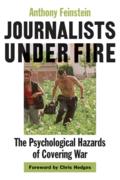
Journalists under Fire: The Psychological Hazards of Covering War
Baltimore: John Hopkins University Press (2006), xiv, 195 pp.
"As journalists in Iraq and other hot spots around the world continue to face harrowing dangers and personal threats, neuropsychiatrist Anthony Feinstein offers a timely and important exploration into the psychological damage of those who, armed only with pen, tape recorder, or camera, bear witness
...
Embedded journalists in the Iraq war: Are they at greater psychological risk?
Journal of Traumatic Stress, volume 18, issue 2 (2005), pp. 129-132
"The current war in Iraq saw an alliance between the media and the military, a process called embedded journalism. The aim of this study was to explore whether this process affected the journalists' vulnerability to psychological distress. Eighty-five of 100 journalists approached agreed to particip
...