Filter
6
Topics
Non-Western Communication Approaches
6
Philosophies of Communication & Media
4
Ethics in Media & Communication
2
Multiculturalism
1
Religion and Development
1
Development Communication Theories
1
Ubuntu (Ethical Concept of Southern African Origin)
1
Intercultural Communication, Intercultural Competencies
1
Globalisation: Impact on (Local) Media & Communication
1
Buddhism and Communication
1
Islam and Communication
1
Theories of Communication & Media
1
Language
Countries / Regions
Authors & Publishers
Media focus
Publication Years
Output Type
Development and Communication in Sri Lanka: A Buddhist Approach
In: The Global Intercultural Communication Reader
New York; London: Routledge, 2nd ed. (2014), pp. 467-479
"According to Dissanayake, the Sarvodaya movement encompasses the ideal of the harmonious social order and the principle of self-reliance and self-transformation as envisioned and encouraged by Buddhist teaching. The Sarvodaya movement also duly asserts that the idea of development should include no
...
Nommo, Kawaida, and Communicative Practice: Bringing Good Into the World
In: The Global Intercultural Communication Reader
New York; London: Routledge, 2nd ed. (2014), pp. 211-225
"In this chapter, Maulana Karenga explores ancient and ongoing African traditions of communicative practice in understanding African American rhetoric. For Karenga, African rhetoric is essentially the communicative practice that is oriented to building community and bringing good into the world, whi
...
The Two Faces of Chinese Communication
In: The Global Intercultural Communication Reader
New York; London: Routledge, 2nd ed. (2014), pp. 273-282
"In this chapter, Guo-Ming Chen portrays two faces of communication in Chinese culture. He thematizes harmony, one of the core Chinese cultural values, to paint a picture of the first face. According to him, in order to achieve harmony, Chinese people would (1) follow the principles of jen (benevole
...
The Functions of Silence in India: Implications for Intercultural Communication Research
In: The Global Intercultural Communication Reader
New York; London: Routledge, 2nd ed. (2014), pp. 248-254
"Although it is often viewed negatively in the West, silence is interpreted as a sign of interpersonal sensitivity, mutual respect, a sens of personal dignity, affirmation, and wisdom in the cultural context of India. At the individual level, silence serves as the means for the individual soul to ac
...
Communication and Cultural Settings: An Islamic Perspective
In: The Global Intercultural Communication Reader
New York; London: Routledge, 2nd ed. (2014), pp. 237-247
"In this chaper, Hamid Mowlana elucidates four cardinal concepts of the Islamic worldview that may serve as the fundamental principles of ethical communication in Muslim societies: (1) tawhid (unity, coherence, and harmony of all in the universe), (2) amr bi al-ma'ruf wa nahy'an al munkar (commandin
...
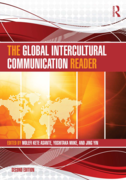
The Global Intercultural Communication Reader
New York; London: Routledge, 2nd ed. (2014), xiii, 586 pp.
"The collection covers a wide range of topics: the emergence and evolution of the field; issues and challenges in cross-cultural and intercultural inquiry; cultural wisdom and communication practices in context; identity and intercultural competence in a multicultural society; the effects of globali
...