Filter
36
Featured
Free Access
36
Key Guidance
3
Quick Overview
2
Top Insights
2
Topics
Media Assistance in Conflict Regions & Fragile Countries
9
Conflict Areas: Media Systems, Media Landscapes, Role of Media
5
Hate Speech, Hate Speech in Social Media
5
Digital Activism, Cyber Advocacy
3
Conflict Prevention, Mediation & Reconciliation: Role of Media
3
Conflict Reporting, Armed Conflict Reporting
3
Digital Media Censorship, Control & Filtering, Internet & Social Media Censorship
2
Conflicts and Media
2
Conflicts & Wars: Roles of Digital Technologies & Conflict Narratives in Social Media
2
Extremist & Terrorist Digital / Social Media Presence
2
Twitter & Microblogs
2
Countering Hate Speech, Disinformation & Propaganda
2
Self-Regulation of Media
2
Evaluation in Conflict & Fragility Settings
2
Crowdsourcing
2
Trust in the Media, Credibility of Media
1
Authoritarian Regimes: Media Systems & Landscapes
1
Censorship
1
Censorship Circumvention Tools & Strategies
1
Internet Censorship Circumvention Tools & Strategies
1
Media Freedom, Press Freedom
1
Foreign Government Communication Interventions
1
International Organizations: Communication Strategies & Practices
1
Conflicts, Conflict Prevention & Management, Mediation, Peacebuilding
1
Ethnic Conflicts
1
Civil Wars
1
Conflict-Sensitive Digital Technology Use & Social Media in Prevention & Transformation
1
Extremism & Terrorism Reporting
1
Extremist & Terrorist Communication Strategies and Media
1
Information Warfare, Psychological Warfare
1
Internet / ICTs and Conflicts
1
Media Law & Regulation in Conflict Areas
1
Media Monitoring, Media Observatories
1
Development Assistance
1
Development Projects: Planning & Implementation
1
Digital Inclusion
1
Digital Media Research, Digital Communication Research
1
Digital Research Methods
1
Digital Financial Services, Mobile Banking, Mobile Payphone Business
1
Democratization & Digital Media / Social Media
1
Social / Digital Media and ICTs in Disaster & Humanitarian Crisis Management & Prevention
1
Digitalisation, Online Communication & Democracy / Democratization
1
Mobile Phone Markets
1
Minorities & Disadvantaged Groups: Reporting & Media Representation
1
Bias in News Media
1
Standards, Ethics in Evaluation, Codes of Conduct
1
Development Projects: Evaluation, Monitoring, Impact Assessment
1
Evaluation Criteria, Evaluation Indicators
1
Evaluation Design & Implementation
1
Evaluation Methods, Evaluation Tools
1
Media Assistance: Evaluation, Monitoring, Impact Assessment
1
Terms of Reference in Evaluation
1
Using Evaluation Results, Learning from Evaluations
1
Ethnicity in Communication
1
China: Transnational Information Operations, International Broadcasting, Public Diplomacy
1
International Relations
1
Journalists
1
Election Reporting
1
Media Assistance: Country Strategies & Experiences
1
Media Assistance: Project Planning & Implementation
1
Ushahidi (Crowdsourcing Mapping Software)
1
Media Landscapes, Media Systems, Media Situation in General
1
Radio Landscapes
1
Accountability & Transparency
1
Election Monitoring
1
Influence of Media on Politics
1
Political Transition and Media
1
Local Ownership, Local Stakeholder Participation
1
Needs Assessment
1
Taliban
1
Mobile Phone Use for Social Purposes, Mobiles for Development
1
Television Channels
1
Reality Television Programmes & Daily Talks
1
Youth and Media
1
Language
Document type
Countries / Regions
Authors & Publishers
Media focus
Publication Years
Methods applied
Output Type

China’s Media Propaganda in Africa: A Strategic Assessment
Washington, DC: United States Institute of Peace (USIP) (2023), 23 pp.
Beyond Fake News: The Central African Republic’s Hate Speech Problem
United States Institute of Peace (USIP), August 16 (2021)
"After a recent contested election, the Central African Republic finds itself in a precarious situation. Violence around the election combined with the socio-economic impacts of COVID-19 and destructive flooding have caused the humanitarian emergency to reach its worst state in five years. Meanwhile
...
Un lexique de discours haineux et incendiaire en République Centrafricaine
Quick Overview
Washington, DC: PeaceTech Lab; United States Institute of Peace (USIP); Association Jeunesse en Marche pour le Développement en Centrafrique (AJEMADEC) (2021), 38 pp.
"Depuis 2014, PeaceTech Lab a entrepris des recherches et travaillé avec des partenaires locaux dans 13 pays pour comprendre la dynamique des discours de haine et le lien entre la prolifération des récits haineux en ligne et les événements violents hors ligne. Cette recherche et les lexiques qu
...
A Lexicon of Hateful and Inflammatory Speech in the Central African Republic
Quick Overview
Washington, DC: PeaceTech Lab; United States Institute of Peace (USIP); Association Jeunesse en Marche pour le Développement en Centrafrique (AJEMADEC) (2021), 38 pp.
"Since 2014, PeaceTech Lab has undertaken research and worked with local partners in 13 countries to understand the dynamics of hate speech and the connection between the proliferation of hateful narratives online and violent events offline. This research and the resulting lexicons seek to identify
...
Digital Authoritarianism and Nonviolent Action: Challenging the Digital Counterrevolution
Washington, DC: United States Institute of Peace (USIP) (2021), 23 pp.
"This report examines how use of newer and emergent technologies affects nonviolent action campaigns. It identifies two significant related challenges and presents evidence of these dynamics at work in two digital autocracies, China and Russia." (About the report)
Digital Inclusion in Mediated Peace Processes: How Technology Can Enhance Participation
Washington, DC: United States Institute of Peace (USIP) (2020), 44 pp.
"Inclusion in peace processes is conventionally understood in “offline” terms, such as being physically present at the negotiation table. However, digital technology can support a mediator’s efforts to integrate a broad variety of perspectives, interests, and needs into a peace process. This r
...
The Need for a New US Information Strategy for North Korea
Washington, DC: United States Institute of Peace (USIP) (2019), 19 pp.
"Drawing on relevant literature, analysis of North Korean media and information control techniques, and interviews with refugees and defectors, this report argues that a new US information strategy is needed to alleviate the social isolation of the North Korean people and improve their long-term wel
...
Donor Assistance in the Transparency and Accountability Movement
Washington, DC: United States Institute of Peace (USIP) (2019), 36 pp.
Libyan Television and its Influence on the Security Sector
Washington, DC: United States Institute of Peace (USIP) (2015), 8 pp.
"The Libyan security landscape is broadly divided into two camps: revolutionary-Islamist and institutionalist-conservative. The country’s resurgent media sector is split along similar lines. This polarization and related partistan reporting reinforce polarization among security sector actors and t
...
Afghanistan’s Fourth Estate: Independent Media
Washington, DC: United States Institute of Peace (USIP) (2015), 4 pp.
"Over the last decade, Afghanistan has experienced the rise of a robust media sector. Programming fills the airwaves with everything from news to comedy, open debate to open audition, soap operas to police dramas to ABCs. Journalists, however, operate in a climate of fear and insecurity, under threa
...
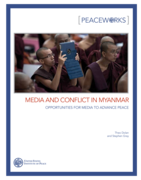
Media and Conflict in Myanmar: Opportunities for Media to Advance Peace
Washington, DC: United States Institute of Peace (USIP) (2014), 36 pp.
"This study is based on the Intended Outcomes Needs Assessment (IONA) methodology and assesses the changing relationships between media and conflict in Myanmar. Findings reveal a deeply rooted, intractable, and dynamic conflict landscape. Analysis focuses on three key conflicts: citizen-state, ethni
...
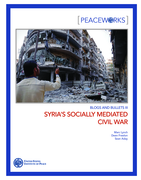
Syria's Socially Mediated Civil War
Washington, DC: United States Institute of Peace (USIP) (2014), 33 pp.
"Analysis of the unprecedented use of social media on Syria points to important findings on the role of new media in conflict zones. In particular, social media create a dangerous illusion of unmediated information flows. Key curation hubs within networks may now play a gatekeeping role as powerful
...
PakVotes: A Social Media Experiment in Elections Monitoring
Washington, DC: United States Institute of Peace (USIP) (2014), 5 pp.
"PakVotes, a pilot project supported by the U.S. Institute of Peace (USIP), used social media platforms and a network of reporters located in areas outside of major cities in Pakistan to track violence during the 2013 elections. The project offers lessons that could guide future efforts to use socia
...
Social Media Reporting and the Syrian Civil War
Washington, DC: United States Institute of Peace (USIP) (2013), 3 pp.
"The lack of traditional reporting and verifiable journalistic reports about the ongoing conflict in Syria has led to an increased dependence on social media as a source of news. But assessing the veracity of these reports has proven extremely difficult, creating consistent distortions of Syria’s
...
Mitigating Media Incitement to Violence in Iraq: A Locally Driven Approach
Washington, DC: United States Institute of Peace (USIP) (2013), 17 pp.
"The Iraqi media sector is polarized, with news content often representing political positions. In a postconflict environment such as Iraq, this polarized content can become inflammatory, potentially inciting violence and diminishing the chances for Iraq to move forward in its transition to a peacef
...
New Media and Conflict After the Arab Spring
Washington, DC: United States Institute of Peace (USIP) (2012), 24 pp.
"An extraordinary wave of popular protest swept the Arab world in 2011. Massive popular mobilization brought down long-ruling leaders in Tunisia and Egypt, helped spark bloody struggles in Bahrain, Libya, Syria, and Yemen, and fundamentally reshaped the nature of politics in the region. New media -
...
Communication for Peacebuilding Priority Grant Program: Learning Group Report
Washington, DC: United States Institute of Peace (USIP) (2012), 16 pp.
"This report summarizes the findings of the learning group that was formed by the three grantees of USIP’s 2011 Communication for Peacebuilding priority grant program: Radio La Benevolencija in the Democratic Republic of Congo; Internews Network in the Central African Republic; and The World Polic
...
Evaluating Media Interventions in Conflict Countries: Toward Developing Common Principles and a Community of Practice
Washington, DC: United States Institute of Peace (USIP) (2011), 35 pp.
"A wide array of media development practitioners, donors, international broadcasters, and methodologists, all with extensive experience working in media initiatives in conflict environments met in Caux, Switzerland, in December 2010, to establish the Caux Guiding Principles, whose full text is in th
...
Covering and Countering Extremism in Pakistan’s Developing Media
Washington, DC: United States Institute of Peace (USIP) (2011), 3 pp.
"With a rise in terrorist activity spreading fear through highly publicized attacks, Pakistan’s media landscape has increasingly been used as a battleground between those seeking to promote violent conflict and others seeking to manage or deter it. Pakistan’s media community has not yet develope
...

Media in Fragile Environments: The USIP Intended-Outcomes Needs Assessment Methodology
Key Guidance
Washington, DC: United States Institute of Peace (USIP) (2011), 64 pp.
"Over the past twenty years, media interventions have become an accepted tool for conflict management. Interventions have often proven ineffective, however, because they lacked clear definition of their intended outcomes. This volume presents an Intended-Outcomes Needs Assessment methodology (IONA)
...