Filter
23
Topics
Authoritarian Regimes: Government Communication Strategies
3
Independent & Oppositional Media in Authoritarian Regimes
2
Russia-Ukraine War <2014-
2
Digital Journalism, Online Journalism
2
Countering Hate Speech, Disinformation & Propaganda
2
Media Law & Regulation
2
RT (Russian International Broadcaster, formerly Russia Today)
2
Access to Media & Information
1
Digital & Social Media Use: Youth
1
Media Law & Regulation: Authoritarian Regimes
1
Textbooks, Textbook Development, Publishing & Research
1
Election Campaigns
1
Public Film Policies, Film Legislation, Public Film Funding
1
Cybersecurity, Digital Safety, Privacy, Right to Privacy
1
Encryption, Cryptology
1
Exile Journalism, Exile Media
1
Censorship
1
Media Freedom, Press Freedom
1
Government Propaganda
1
Nonprofit Public Relations & Marketing
1
Press Releases & Press Conferences
1
Alternative Communication & Media
1
Community Media
1
Conflict Areas: Media Systems, Media Landscapes, Role of Media
1
Contents of Media
1
Creative & Cultural Industries
1
Cultural Policies
1
North South Relations
1
Development Communication, Communication for Development (C4D)
1
Communicating Development Projects, Media in Development Programmes
1
Development and Media
1
Internet / Social Media Law & Regulation
1
ICT Industries & Markets
1
LGBT & Communication / Media
1
Disinformation, Misinformation, Fake News
1
Foreign Disinformation, Foreign Information Manipulation Operations, Foreign Propaganda
1
Local Media Economics & Markets, Local Media Financing
1
Financial Sector, Banks
1
Industrialized Countries
1
Climate Change Communication, Climate Journalism
1
Fact-Checking & Verification of Sources
1
Responsibility
1
China: Transnational Information Operations, International Broadcasting, Public Diplomacy
1
China: Foreign Policy, Foreign Investments, Development Assistance
1
Journalism
1
Journalism Education & Training
1
Journalistic Quality
1
Journalists
1
Local Journalism
1
Photojournalism
1
Local Communication & Media
1
Media Assistance
1
Media, Mass Media
1
Media & Communication Policies
1
Public Funding & Support Policies for Media
1
Tax Reductions for Media
1
Media Landscapes, Media Systems, Media Situation in General
1
Human Rights
1
Migration & Refugees Reporting & (Social) Media Representation
1
Popular Music
1
Rural Press
1
Cyberpsychology
1
Digital Wellbeing, Digital Resilience, Digital Mental Health
1
Media Effects
1
Taliban
1
Antisemitism
1
Society & Media, Media Sociology
1
Blockchain Technologies
1
Youth Cultures, Youth Milieus, Youth Identities
1
Language
Document type
Countries / Regions
Authors & Publishers
Media focus
Publication Years
Methods applied
Output Type


Deprived and Silenced: The Taliban and Suppression of Access to Information
Potsdam: Friedrich Naumann Stiftung (2024), 16 pp.
"Before the Taliban‘s return in 2021, Afghanistan had made notable strides in promoting transparency and civic engagement through progressive laws governing information access. These landmark measures, praised internationally, represented small but significant steps toward strengthening the countr
...

Russian Media in the Balkans and their Role in the Aggression against Ukraine. Case Study: RT Balkan
Potsdam: Friedrich Naumann Stiftung (2024), 37 pp.
"The study presented here [...] is not limited to generalised theses and descriptions of the Balkan media scene under Russian influence that only scratch the surface. Rather, the focus is on documenting the effectiveness of Russian state media in the region with a focus on Serbia, which also has an
...



India: Trailblazer in Tech-Emancipation from China
New Delhi: Friedrich Naumann Stiftung (2023), 39 pp.
"Over the past few years, India has taken decisive steps to reduce its dependence on Chinese technology and investments. This was triggered by border skirmishes with China in 2020, but built on longstanding national security concerns about China, given the history of conflict between the two countri
...

The Global Battle of Narratives: China’s Media Influence in Thailand
Potsdam: Friedrich Naumann Stiftung (2023), 14 pp.

Das digitale Briefgeheimnis: Herleitung des Rechts auf Verschlüsselung
Potsdam: Friedrich Naumann Stiftung (2023), 26 pp.
"1. Aus dem nationalen Verfassungsrecht ist ein Recht auf Verschlüsselung ableitbar.
2. Aus dem europäischen Verfassungsrecht ist ein Recht auf Verschlüsselung ableitbar.
3. Ein Recht auf Verschlüsselung ergibt sich zwar nicht als solches aus den nationalen und europäischen verfassungsrechtlich
...

Pressemeldungen mit Wirkung: Praxishandbuch für erfolgreiches Schreiben
Potsdam: Friedrich Naumann Stiftung (2023), 46 pp.
"Hier lernen Sie, was eine Pressemeldung bereits benötigt, bevor Sie sie formuliert haben, und warum Relevanz so wichtig ist. Jede Pressemeldung braucht einen Anlass. Dieses Handbuch erklärt Ihnen, wie solche Anlässe aussehen können und welche Kriterien diese erfüllen sollten, um medienwirksam
...

Russische Medien in Deutschland. Die Bundestagswahlen 2021 – Zwischen Einflussnahme und Desinformation
Potsdam: Friedrich Naumann Stiftung (2022), 29 pp.
"Während in Russland immer mehr unabhängige Medien der staatlichen Kontrolle unterworfen und als „ausländische Agenten“ gebrandmarkt werden, nutzen die russischen Staatsmedien die Meinungs- und Pressefreiheit in Deutschland, um ungehindert Desinformation zu verbreiten. Nach acht Jahren Berich
...

Russlands unabhängiger Journalismus: Der harte Überlebenskampf unter totalitären Repressionsmaßnahmen
Potsdam: Friedrich Naumann Stiftung (2022), 39 pp.
"Der Journalist und Verleger Sergej Parkhomenko ist ein international gefeierter Menschenrechtsverteidiger, Oppositionsaktivist und unter den russischen Medienschaffenden einer der wichtigsten Partner für das Internationale Journalisten- und Mediendialogprogramm (IJMD) der Friedrich-Naumann-Stiftun
...
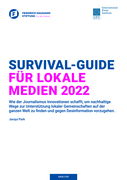
Survival-Guide für lokale Medien: Wie der Journalismus Innovationen schafft, um nachhaltige Wege zur Unterstützung lokaler Gemeinschaften auf der ganzen Welt zu finden und gegen Desinformation vorzugehen
Potsdam; Wien: Friedrich Naumann Stiftung; International Press Institute (IPI) (2022), 20 pp.
"Die Schlüsselfragen für den Erfolg lokaler Nachrichtenmedien sind die folgenden: Lösen Sie ein Problem für ihre Zielgruppe? Identifizieren und füllen sie eine Nachrichten- oder Informationslücke für ihre Gemeinschaft bzw. Gemeinschaften? In diesem Bericht beschäftigen wir uns damit, wie Jou
...


Die Klima- und Umweltproblematik als Thema in Politik- und Wirtschaftsschulbüchern: Eine Schulbuchanalyse für die Sekundarstufe II mit Fokus auf umweltökonomischen Erklärungs- und umweltpolitischen Lösungsansätzen
Potsdam: Friedrich Naumann Stiftung (2022), 29 pp.
"Der Klimawandel ist eine der größten Herausforderungen unserer Zeit. Schulen tragen eine große Verantwortung, junge Menschen mit dem nötigen Wissen über Ursachen und Lösungsmöglichkeiten auszustatten. Die Studie des Instituts für ökonomische Bildung (IÖB) zeigt allerdings, dass Schülerin
...

New money. Bitcoin and cryptoassets in Central America: The case of El Salvador
Potsdam: Friedrich Naumann Stiftung (2022), 16 pp.
"El Salvador’s experiment, though mired with fiscal and political issues from before, has shown that the adoption of public blockchain assets like Bitcoin are not taken in good regard by legacy financial multilateral institutions and are seen with great skepticism and concern. Although the adoptio
...

How to Counter Disinformation: 10 Strategic Demands
Potsdam: Friedrich Naumann Stiftung (2021), 8 pp.
"1 Words matter: Use the correct terms
2 Images and emotions: Understanding the entire range of disinformation
3 Creating structures for the digital education of every age group
4 Securing the freedom of expression: Smart regulation against overblocking
5 A modern constitutional state
6 Focus on tec
...

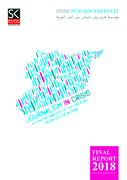
Journalism in Crisis: A Content Analysis of the Emerging Media Sector in Syria
Beirut: Samir Kassir Foundation; Friedrich Naumann Stiftung (2018), 44 pp.
"This study reveals that news briefs are the most commonly found type of pieces published in the emerging Syrian media sector. Together, news briefs, news reports and feature stories constitute 90 percent of what was published during the monitoring period. Investigative reports were very rare. News
...