Filter
20
Topics
Environmental Journalism
4
Journalism Education & Training
4
Media Freedom, Press Freedom
3
Post-Socialist Media Systems & Landscapes
2
Access to Internet & Digital Communications
1
Digital Media Censorship, Control & Filtering, Internet & Social Media Censorship
1
Media / Communication Control
1
Censorship
1
Harassment & Intimidation of Journalists
1
Public Diplomacy, Cultural Diplomacy
1
Conflict Reporting, Armed Conflict Reporting
1
Digital Journalism, Online Journalism
1
Political Blogging
1
Disadvantaged Groups & Communication, Minorities & Media
1
Prisoners & Communication / Media
1
Journalism Ethics
1
Mental Health Reporting & Media Representation
1
Suicide Reporting & Media Representation
1
Colonial Legacies
1
Foreign News, International News
1
Journalism
1
Journalism Education Curricula
1
Journalists Dealing with Risks & Threats, Resilience & Wellbeing of Media Workers
1
Religion: Media Representation
1
Science Journalism
1
Media Landscapes, Media Systems, Media Situation in General
1
Media Law & Regulation
1
Religious Freedom
1
Voice of America
1
Politics and Media
1
Democracy / Democratization and Media
1
Political Transition and Media
1
Language
Document type
Countries / Regions
Authors & Publishers
Media focus
Publication Years
Methods applied
Journals
Output Type
Ethics and Journalism in Central Asia: A Comparative Study of Kazakhstan, Kyrgyzstan, Tajikistan and Uzbekistan
Journal of Media Ethics, volume 35, issue 1 (2020), pp. 31-44
"This study analyzes professional ethical perspectives and practices of Central Asian journalists by examining and comparing the four former Soviet republics of Kazakhstan, Kyrgyzstan, Tajikistan, and Uzbekistan. This study uses in-depth interviews with 24 journalists to examine their ethical ideals
...
In the crosshairs: The perils of environmental journalism
Journal of Human Rights, volume 19, issue 3 (2020), pp. 275-290
"Journalists covering environmental issues around the globe are at heightened risk of murder, arrest, assault, threats, self-exile, lawsuits, and harassment because environmental controversies often involve influential business and economic interests, political power battles, criminal activities, an
...
WHO’s Media Guidelines in the Press and in Public Perception
Journal of Media Ethics, volume 33, issue 1 (2018), pp. 14-25
"This study based on a content analysis and a nationwide survey examines Taiwan’s suicide coverage and general public evaluations of the World Health Organization media guidelines, alongside the copycat effect. Key findings show the daily newspaper Apple Daily essentially failed to follow the guid
...
Journalism after jail: Coping with the trauma of imprisonment
Media Asia, volume 44 (2017), pp. 21-24
"Journalists continue to face imprisonment for practicing their profession in ways that antagonize regimes, militaries, oligarchs, and other powerful interests. What do journalists do after their release from prison? Do they resume their professional work in their home country or in exile? How do th
...

Press Coverage of Environmental News in Kyrgyzstan and the Role of Eco-Nongovernmental Organizations
Central Asia and the Caucasus, volume 16, issue 2 (2015), pp. 144-160
"This article explores obstacles and conditions that environmental nongovernmental organizations face in interacting with media outlets in Kyrgyzstan. It also examines the limited scope of environmental journalism and the resulting limited ability of news outlets and eco-NGOs to help set the public
...

Barriers to Coverage of Transborder Environmental Issues in the Ferghana Valley of Central Asia
Applied Environmental Education & Communication, volume 13, issue 1 (2014), pp. 48-55
"Three former Soviet republics occupy Central Asia's Ferghana Valley, a region of serious transborder environmental problems, especially ones that involve water and energy. Most news organizations in Kyrgyzstan, Tajikistan, and Uzbekistan provide little in-depth coverage of these issues. Journalists
...

Social Media, Cyber-Dissent, and Constraints on Online Political Communication in Central Asia
Central Asia and the Caucasus, volume 13, issue 1 (2012), pp. 144-152
"This paper reviews recent events and legal developments related to the Internet and social media in Kazakhstan, Kyrgyzstan, Tajikistan Turkmenistan, and Uzbekistan. They include legislation extending libel laws to online communications, blocking of oppositional and independent websites, and punishi
...
Media Watch and Journalism Rights Organisations as Advocates of Press Freedom in Post-Soviet Central Asia
Journal of Development Communication, volume 23, issue 1 (2012), pp. 56-75
"In the bleak press rights territory of post-Soviet Central Asia, domestic and international nong-overnmental organisations, foreign governments, news outlets, and multinational entities such as the Organization for Cooperation and Security in Europe (OSCE) and UNESCO monitor constraints on the pres
...
Deepening Shadows: The Eclipse of Press Rights in Kyrgyzstan
Global Media and Communication, volume 8, issue 1 (2012), pp. 47-64
"In March 2005, a relatively nonviolent uprising ousted an authoritarian president in the former Soviet republic of Kyrgyzstan. In the aftermath of the so-called Tulip Revolution, press rights advocates and journalists welcomed the promise of greatly enhanced freedoms. However, the new regime proved
...
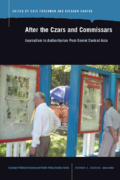
After the Czars and Commissars: Journalism in Authoritarian Post-Soviet Central Asia
East Lansing: Michigan State University Press (2011), 299 pp.

New Developments in Central Asian Mass Media Research
Central Asia and the Caucasus, volume 12, issue 4 (2011), pp. 128-143
"This wide range of contemporary mass media research illustrates how Central Asia press outlets remain tightly controlled and manipulated, first under the czars, then under the Soviets, and now under authoritarian regimes. Over the past two decades, the press systems have not achieved even minimal d
...

Environmental Journalism in Kyrgyzstan and Kazakhstan: Reporting Scarce Amid Environmental and Media Problems
Applied Environmental Education & Communication, volume 10, issue 2 (2011), pp. 126-134
"Independence for the former Soviet republics of Kazakhstan and Kyrgyzstan in Central Asia has not led to press freedom, solutions to pressing environmental problems, or development of effective grassroots nongovernmental organizations. This article examines relations between journalists and environ
...

Authoritarian Regimes, Muslims' Religious Rights in Central Asia, and Lack of Foreign Press Coverage of Rights Violations
Central Asia and the Caucasus, volume 11, issue 1 (2010), pp. 146-158
"Today, extended geographical links are the most important yet far from the only factor that makes Central Eurasia highly significant for China's conceptualization of its security. The Soviet Union's disintegration, which created newly independent states, also generated favorable conditions for Chin
...

Controversy on the Airwaves: Public Diplomacy, Portraying America, and Public Outreach Through the Voice of America Uzbek Service
Central Asia and the Caucasus, volume 11, issue 4 (2010), pp. 110-125
"From a research perspective, this case study highlights the need for further research into BBG-sponsored international broadcast services, both individually and collectively. Such studies could include quantitative content analyses of program content, survey research of listeners and viewers, inter
...
Press Constraints as Obstacles to Establishing Civil Societies in Central Asia: Developing a New Model of Analysis
Journalism Studies, volume 10, issue 6 (2009), pp. 851-869
"More than a decade and a half after independence, none of the press systems in Central Asia's five former Soviet republics are categorized as free, nor have any of these countries transitioned to democracy. The question becomes: Why have they failed to evolve into democratic nations after successfu
...

Defending the Inverted Pyramid Style: Advocating an Emphasis on Teaching Traditional Practices in International Journalism Education
Communication & Social Change, volume 2, issue 1 (2008), pp. 140-158
"The United Nations Educational, Scientific, and Cultural Organization has prepared model curricula intended to improve international journalism education. While the overall goal is worthy, serious obstacles exist to its implementation in the "developing countries and emerging democracies" if it is
...

Covering Religion-Related News and Conflicts in the Caucasus: A Case Study of a Western “Christian Initiative” News Service
Caucasus Journal of Social Sciences, volume 1, issue 1 (2008), pp. 150-175
"This study examines how a Christian-oriented Western press organization [Forum 18 News Service, Norway] covers religion-related news in the Caucasus. Coverage in 2005 overwhelmingly focused on Christianity. Although governmental sources are more likely to be cited than religiously affiliated source
...

Coverage of the Central Asian Political, Press, and Speech Rights Issues by Independent News Websites
Asia Pacific Media Educator, issue 16 (2005), pp. 71-88
"Since independence in 1991, the Central Asian republics to varying degrees have given lip service to democratization and the recognition of free press and political rights. However, the reality has been dramatically different under all five authoritarian regimes. That reality includes limits or ban
...

Designing and Implementing the First Environmental and Science Journalism Course for an Uzbekistan Journalism School
Applied Environmental Education & Communication, volume 3, issue 3 (2004), pp. 153-161
"Uzbekistan faces severe ecological problems including the rapidly shrinking Aral Sea, desertification, residues of biochemical weapons, and environmentally related respiratory disease. Even so, the country’s print and broadcast media do little in-depth or analytical reporting on environmental iss
...

Obstacles to the Professionalization of Mass Media in Post-Soviet Central Asia: A Case Study of Uzbekistan
Journalism Studies, volume 4, issue 1 (2003), pp. 91-103
"Uzbekistan is the most populous and economically significant of the five Central Asian republics of the former USSR. Although authoritarian, its government appears to recognize the need to train journalists in Western journalistic theory and practice. The observations and experiences of the authors
...