Filter
42
Topics
Media Use, Media Consumption
37
News Consumption & Information Sources of Media Users
11
Digital & Social Media Use, Internet Use
10
Mobile Phone Use
6
Trust in the Media, Credibility of Media
3
Politics
2
Media & ICT Use in Authoritarian Regimes / Dictatorships
1
Media Use: Foreign / International Media
1
Media Use: Migrants & Diasporas
1
Media Use: Women, Female Media Audiences
1
Television Consumption, Televison Use, Television Audiences
1
Cybersecurity, Digital Safety, Privacy, Right to Privacy
1
Surveillance, Surveillance Technologies, Spyware
1
Gender Relations
1
Image Abroad
1
Satellite Television
1
Transnational Television, International Television
1
Interpersonal Communication, Interpersonal Relations
1
Telecommunication Industries & Markets
1
Language
Countries / Regions
Authors & Publishers
Media focus
Publication Years
Methods applied
Output Type
Media Consumption in Turkey
Broadcasting Board of Governors (BBG); Gallup (2017), 46 slides
"Turks still have a large number of media outlets available to them, though press freedom is increasingly circumscribed. A significant portion of the population – especially among the better educated – express some degree of dissatisfaction with Turkish media. No single media outlet enjoys clear
...
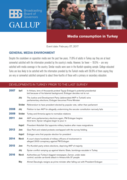
"About two-thirds of Turkish adults (65.0%) currently say they go online for news at least weekly. Among Kurdish speakers, that figure is much higher at 70.8%. Half of all residents (50.2%) say they use newspapers or magazines for news every week. While four in five adults (80.5%) say they get news
...
Assessing Russia’s Influence in its Periphery
Broadcasting Board of Governors (BBG); Gallup (2016), 40 slides
"Russian speakers in Estonia, Latvia and Lithuania rank Kremlin-backed media as the least trustworthy among international, Russian Federation and domestic news sources, according to research presented by the Broadcasting Board of Governors. In addition, only those survey respondents who considered R
...

Media Consumption in Iraq
Broadcasting Board of Governors (BBG); Gallup (2016), 52 slides
"Key takeaways: Internet use is increasing rapidly, but not replacing TV; Increases vary significantly by province; Internet trends will change as Iraqi government and ISIS vie for control of media." (Slide 32)
"Kurds live in a different media environment and rely primarily on Kurdish language TV; D
...
Media Consumption in Iraq
Broadcasting Board of Governors (BBG); Gallup (2016), 2 pp.
"As in much of the Arab World, satellite TV is almost ubiquitous in Iraq and Iraqi Kurdistan, present in 97.9% of households (versus 31.5% with radio and 60.1% with the internet). Ethnic Kurds and those with a college degree are much more likely than other Iraqis to have internet access at home. Mor
...
Africa Online: Media Use in Sub-Saharan Africa. Findings from the Media Survey - Côte D’Ivoire, Ethiopia, Kenya, Nigeria and Zimbabwe
Broadcasting Board of Governors (BBG); Gallup (2015), 29 slides
"Internet users in Africa tend to be young, educated and in urban areas. The probability of using the internet is also higher for male, and we also find that internet usage patterns differ across gender and location. Mobile phones are the major devices used to go online both at home and elsewhere by
...
Afghanistan at a Glance: Findings from the World Poll. Media Use for News in Afghanistan
Gallup; Broadcasting Board of Governors (BBG) (2015), 40 slides
"Afghanistan had the highest rate of suffering in the world for 2013 and 2014. Those with a post-secondary education are the most avid media users for news overall. Highly educated Afghans were more likely to use TV, radio, Internet, SMS, and social media on a daily basis for news than other segment
...
The Changing Media Landscape in Vietnam
Broadcasting Board of Governors (BBG); Gallup (2015), 38 slides
"Vietnam has a highly engaged, optimistic and entrepreneurial population and a rapidly changing media environment. Television remains the most used medium and the top source for news and information ¡V especially from official TV. Vietnam severely restricts its news media but Vietnamese want their
...
Media Use in Vietnam
Broadcasting Board of Governors (BBG); Gallup (2015), 2 pp.
"Vietnam's government-run VTV television network continues to dominate the country's media landscape. However, the current survey also points to a powerful generational shift in media use toward online news sources and less dependence on state TV. This trend is perhaps more clearly reflected in the
...

"As in much of the Arab World, satellite TV is almost ubiquitous in Iraq, present in 97.3% of households (versus 35.1% with radio and 50.4% with the Internet). Ethnic Kurds and those with a college degree are much more likely t han other Iraqis to have Internet access at home; those living in Anbar
...

Media Use in Iraq and Iraqi Kurdistan
Broadcasting Board of Governors (BBG); Gallup (2015), 40 slides
"Key Takeaways: Iraq is divided and in transition. You cannot have an actionable understanding of media habits without analyzing specific "target" audiences. All media platforms matter, depending on the audience." (Slide 33)

Media Use in Afghanistan
Broadcasting Board of Governors (BBG); Gallup (2015), 2 pp.
"The Afghan media scene has experienced tremendous growth in the post-Taliban period, buoyed by international involvement and the passage of a series of laws lending some protection to journalists. Though Reporters Without Borders listed Afghanistan’s media environment 128 out of 179 countries in
...
Newsgathering and Policy Perceptions in Ukraine
Broadcasting Board of Governors (BBG); Gallup (2014), 35 slides
"Use of Ukrainian vs. Russian in news content is not important for the vast majority of adults; trust in content is key to reliance on sources. Ukrainian TV channels remain the top news sources for adults across ethnic groups and regions (other than Crimea), and offer news trusted by large majoritie
...

"Television is the dominant news medium in Ukraine. Almost all Ukrainians (96.8%) watch TV for news at least weekly, including 95.7% of Crimeans. The Internet has overtaken radio and print media as the second most dominant news source in the country, with about half (48.3%) going online for news at
...
"While radio is still in the lead for news consumption in Nigeria, the use of digital media and mobile continues to grow rapidly. The new research also reveals that Nigerian personal mobile phone ownership has increased significantly in 2014 to 83.0%, up from 73.1% in 2012. Mobile web is the leading
...
Contemporary Media Use in Egypt
Broadcasting Board of Governors (BBG); Gallup (2014), 32 slides
Pakistan: Audience Realities in an Unstable Media Landscape
Gallup; Broadcasting Board of Governors (BBG) (2014), 43 slides
"TV is the main information platform by far, but the importance of individual channels varies by region and modes of access. Population is divided between those with access to non-State TV and those without. While most express generic satisfaction with media, actual opinions about specific channels
...
Contemporary Media Use in Nigeria
Broadcasting Board of Governors (BBG); Gallup (2014), 36 slides
"Nigeria is a complex country grappling with serious economic, political, and security challenges. New media are an increasingly effective pathway for reaching Nigerian audiences, especially those who are media rich. However, there remain media poor segments of the population who can only be reached
...